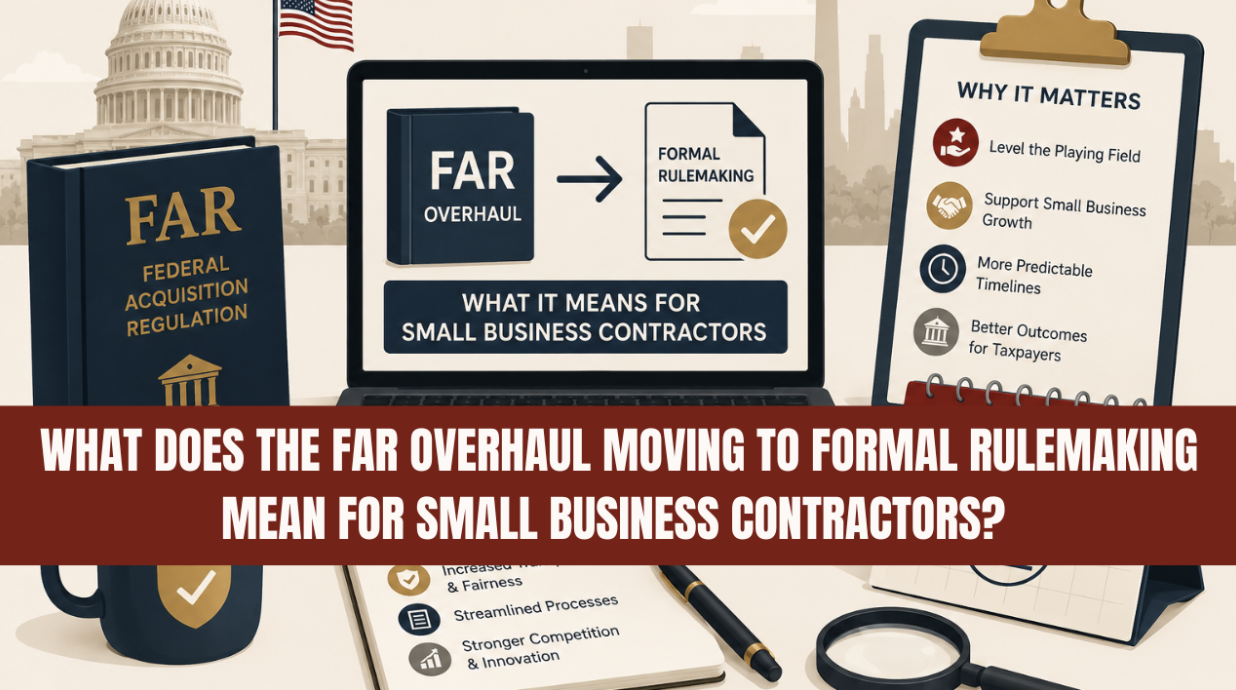
For most of 2026 the FAR Overhaul has lived in a strange place: real enough to follow, but technically temporary. In June 2026 that changed. The FAR Council began converting the overhaul into permanent rules, and for small business contractors the part that matters most, Part 19, is still under review.
The Revolutionary FAR Overhaul (RFO) is the governmentwide rewrite of the Federal Acquisition Regulation launched under Executive Order 14275. Its Phase 1 changes took effect through class deviations starting February 1, 2026, and in June 2026 the FAR Council moved to formal notice-and-comment rulemaking with its first batch of proposed rules. The deviations are operating now; the permanent versions are being finalized.
What Is the FAR Overhaul, in Plain Terms?
The RFO is an effort to strip the FAR down to what statute and core policy require, cutting accumulated regulation that agencies and contractors have built around for decades. It is being rolled out part by part rather than all at once.
The structure so far:
- Executive Order 14275, “Restoring Common Sense to Federal Procurement,” launched the overhaul and set the direction.
- Phase 1 class deviations took effect February 1, 2026, revising a large set of FAR parts. By spring, more than 40 federal agencies had issued their own implementing guidance, and the Department of Defense adopted the revisions as deviations.
- The model deviation text gave agencies a common starting point, which is why the changes spread fast across government.
- Phase 2 is permanent rulemaking, now underway, to lock the deviation changes into the FAR itself through the Federal Register.
The thing to understand: a class deviation is a temporary, agency-level authorization to act differently than the current FAR text. It is binding where adopted, but it is not yet the FAR. That gap is the whole story for 2026.
Why Does “Deviation Now, Rule Later” Matter to You?
Because you are operating under rules that are real but not final, and the final version can differ from the deviation you are following today. That uncertainty is a planning problem, not a reason to ignore the changes.
What it means practically:
- The rules you follow now are binding, even though they are deviations. Agencies are acting on them today.
- The permanent rule may shift after the comment period. Language can change between the deviation and the final FAR text.
- Implementation is uneven across agencies. Two agencies may apply the same RFO part slightly differently depending on their guidance, so read the solicitation, not just the headline.
- The comment period is your window. Formal rulemaking means the public, including contractors, can shape the final language before it locks.
If you are unsure which version of a FAR part actually governs your active solicitation or contract, that is exactly the question to settle before you bid, and a federal market review sorts the deviation from the rule for your situation.
What Should Small Business Contractors Watch in Part 19?
Watch FAR Part 19 closely, because it governs small business programs and set-asides and it remains under review in the rulemaking process. Changes there hit small businesses directly.
Specifics in play:
- FAR Part 19 (Small Business) is still under review as the overhaul moves to permanent rulemaking, so its final form is not settled.
- The small business subcontracting plan clause, FAR 52.219-9, was revised through the model deviation text and supplemental guidance, which affects subcontracting plan requirements.
- Set-aside mechanics matter. How the rewritten Part 19 treats set-asides, size standards, and socioeconomic programs determines competitive access for small firms.
- Subcontracting ties to other 2026 changes. With subcontracting reports now filed in SAM.gov, Part 19 changes and reporting changes are landing in the same window.
For a small business, the move from “considering pursuit” to “actively bidding” now happens under rules in transition. That is manageable, but only if you know which rules apply to the specific opportunity in front of you.
Our Take
The FAR Overhaul rewards contractors who read carefully and punishes ones who assume the rules are static. The biggest risk in 2026 is not the changes themselves; it is operating on the old FAR out of habit, or treating a class deviation as if it were already permanent and getting surprised when the final rule reads differently. The disciplined move is to treat every solicitation as potentially governed by a deviation, confirm which version applies, and watch Part 19 as it finalizes. Small businesses that engage during the comment period also get a rare thing in federal contracting: a chance to influence the rule before they have to live under it. Reading the regulatory terrain accurately, instead of assuming it, is the core of how GSA Verticalization™ keeps clients ahead of changes like this.
Frequently Asked Questions
What is the Revolutionary FAR Overhaul? It is a governmentwide rewrite of the Federal Acquisition Regulation launched under Executive Order 14275 to reduce the FAR to its statutory and essential core. It is being rolled out part by part, first through class deviations and then through permanent rulemaking.
Is the FAR Overhaul in effect now? Yes, in the form of class deviations that took effect starting February 1, 2026 and were adopted by more than 40 agencies, including the Department of Defense. In June 2026 the FAR Council began formal rulemaking to make the changes permanent.
What is the difference between a FAR deviation and the final rule? A class deviation is a temporary, agency-level authorization to act differently than the current FAR text. It is binding where adopted but is not yet part of the FAR. The final rule, issued through notice-and-comment rulemaking, becomes the permanent regulation and can differ from the deviation.
How does the FAR Overhaul affect small businesses? FAR Part 19, which governs small business programs and set-asides, remains under review, and the subcontracting plan clause FAR 52.219-9 was revised. Small businesses should confirm which version applies to each opportunity and watch Part 19 as it finalizes.
Can contractors influence the final FAR rules? Yes. Because the overhaul is now in formal notice-and-comment rulemaking, contractors can submit comments on the proposed rules before they are finalized.
Know Which Rules You’re Actually Bidding Under
The FAR Overhaul is not a future event. It is the environment you are bidding in right now, with deviations live, a final rule forming, and Part 19 still in motion. The contractors who lose here are the ones who assumed the rules sat still.
A federal market review reads your active opportunities against the current deviations, flags where Part 19 changes touch your set-aside strategy, and tells you what to watch as the permanent rules land.
→ Start Your Federal Market Review
The rules are still being written. Knowing which ones apply to you is the difference between a clean bid and a compliance surprise.