
A purchase order arrives on Friday afternoon. The pricing is awkward, the customer is outside your normal market, and nobody is sure whether saying no is allowed.
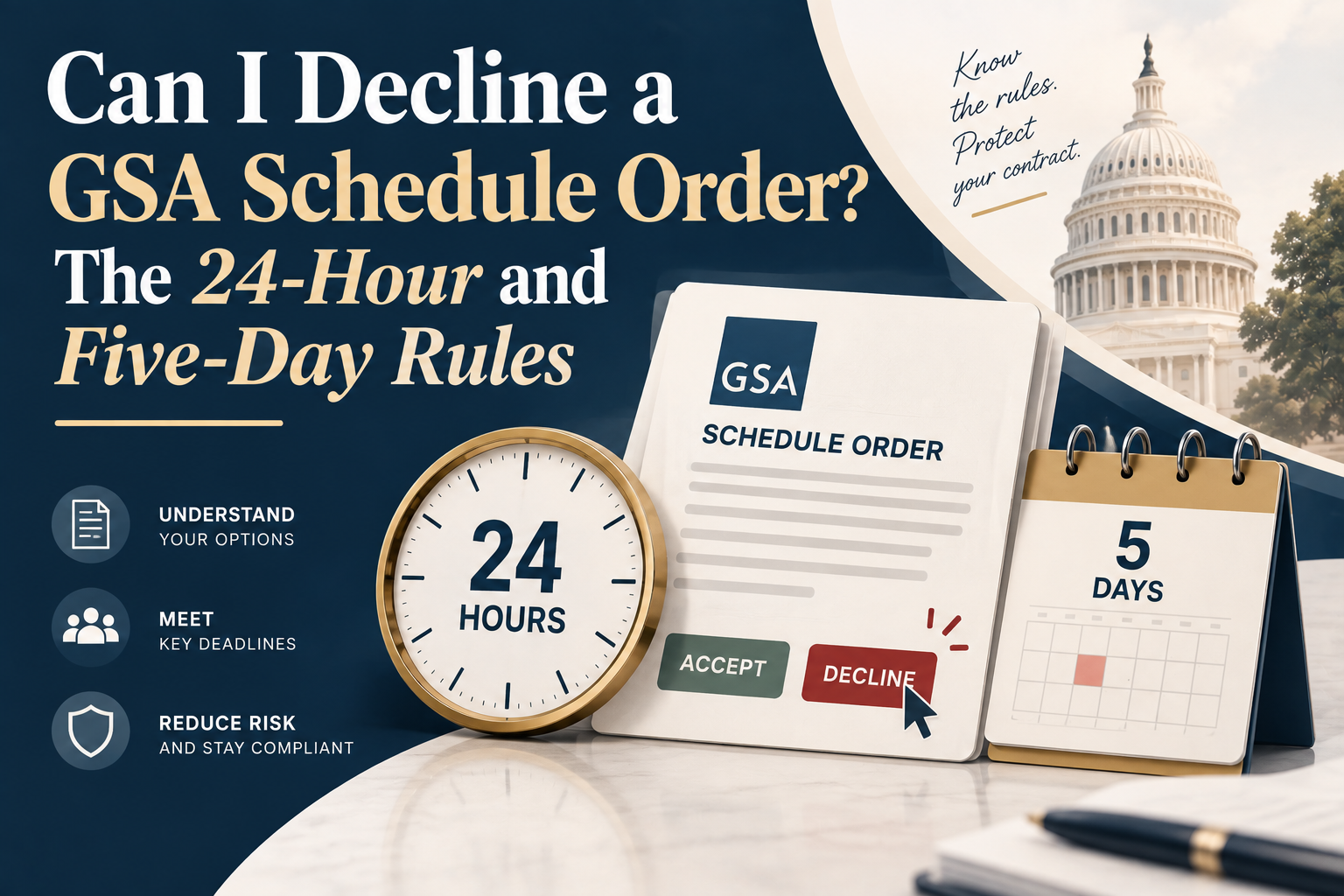
Whether a GSA Schedule contractor can decline an order depends on the buyer, the order amount, and the payment method. Contractors must accept executive-branch orders that fall within the contract’s minimum and maximum order limits. For orders from eligible buyers outside the executive branch, a contractor may decline by returning the order within five working days. For governmentwide commercial purchase-card orders, the contractor must advise the ordering activity within 24 hours or the order is considered accepted.
This is one of the easiest compliance rules to miss because the decision often lands with sales or operations, not a contracts manager. A fast, consistent intake process is the fix.
When Must a Contractor Accept a GSA Schedule Order?
You must accept executive-branch orders that fall within the minimum and maximum order limitations stated in your MAS contract. That obligation comes with holding a Schedule. It is not optional because the order is inconvenient, small, outside your preferred geography, or less profitable than a commercial customer.
Before treating an order as mandatory, verify the basics:
• Is the buyer within the executive branch?
• Is the order within your contract’s stated minimum and maximum order limits?
• Is the requested product or service within your awarded scope?
• Does the order comply with the terms and conditions of your contract?
An order outside your contract scope is not a reason to improvise. It is a signal to review the request, clarify it with the ordering activity, and keep the contract record accurate.
When Can I Decline an Order From an Eligible Buyer?
You may decline an order from an authorized buyer outside the executive branch, such as certain state, local, tribal, or other eligible entities, but you must return the order within five working days if you intend to reject it.
The five-day period is not a courtesy response target. It is the contractual window described in GSA’s post-award requirements. A contractor that lets the order sit without an answer can create confusion for the buyer and unnecessary operational risk for itself. See GSA’s current order-acceptance guidance.
Why Does the 24-Hour Purchase-Card Rule Matter?
For orders that propose payment by the governmentwide commercial purchase card, you must advise the ordering activity within 24 hours after receiving the order. If you do not return the order or advise the ordering activity within the specified time, the buyer considers the order accepted and the MAS contract terms apply.
That rule creates a practical requirement: someone must monitor the order channel when the contracts owner is away. A 24-hour window does not fit a process that relies on a once-a-week inbox check.
| Order Situation | What The Contractor Must Do | Operational Risk |
| Executive-branch order within contract limits | Accept and perform under the contract terms. | Ignoring a mandatory order can create contract-performance exposure. |
| Order from an eligible buyer outside the executive branch | Return it within five working days if you intend to decline. | Silence leaves the buyer and your team without a clear record. |
| Governmentwide commercial purchase-card order | Advise the ordering activity within 24 hours when required. | The order can be treated as accepted if you do not respond in time. |
How Should My Team Handle an Incoming Order?
Use a short intake process that is faster than the deadlines.
1. Log the time received. The clock matters, particularly on purchase-card orders.
2. Identify the buyer and payment method. This determines the initial decision path.
3. Check Schedule scope and order limits. Do not let a sales representative make the decision from a verbal description alone.
4. Confirm performance capacity. Mandatory acceptance does not erase the need to identify staffing, delivery, and fulfillment responsibilities immediately.
5. Respond in writing and retain the record. Your contract file should show what was received, the decision made, and when the ordering activity was advised.
If incoming orders are handled through a general sales inbox, build a written escalation rule. The most expensive version of this problem is not a deliberate rejection. It is a team that did not notice the order until the response window had passed.
What if the Order Requests Work Outside My Schedule Scope?
Do not assume the buyer’s request turns non-Schedule work into Schedule work. A MAS contractor is authorized to provide the products and services awarded under its contract. If the request contains something outside that scope, clarify the requirement before accepting it as a Schedule order.
The answer might involve an existing authorized offering, a correction by the ordering activity, a future contract modification, a Contractor Teaming Arrangement, or another acquisition path. The correct path depends on the requirement. The wrong path is invoicing an unawarded service through the Schedule because the customer asked for it.
If your team regularly receives orders that are almost within scope, it may be time for a GSA Schedule management review of your SIN structure, catalog, and modification plan.
Our Take
Order acceptance is where the Schedule stops being a sales credential and becomes a live federal contract. The companies that manage it well do not need a lawyer to answer every incoming purchase order. They have a clear intake system, assigned decision rights, and a contract record that lets them determine scope quickly.
That is a small operational habit with large consequences. It protects the buyer, the delivery team, and the value of the contract itself.
Related Resources
• How Do I Actually Win Work on My GSA Schedule?
• How to Submit GSA MOD Requests: A Practical Walk-through
Frequently Asked Questions
Can I Refuse Any GSA Schedule Order That Is Not Profitable?
No. Executive-branch orders within the contract’s minimum and maximum order limits must be accepted. Review your order limitations and contract terms before deciding that an order can be declined.
How Long Do I Have to Decline an Order From a State or Local Buyer?
If you want to reject an order from a buyer outside the executive branch, return the order within five working days. Keep a record of the response.
What Happens if I Ignore a Government Purchase-Card Order?
If you do not return the order or advise the ordering activity within the stated 24-hour period, the buyer can consider the order accepted and the MAS contract terms apply.
Can I Decline an Order That Is Outside My Awarded Scope?
You should not accept unawarded work as a Schedule order. Clarify the requirement with the ordering activity and determine the appropriate acquisition or modification path.
Who Should Review Incoming GSA Orders?
The team needs a documented owner and backup who can check buyer eligibility, scope, pricing, delivery capacity, and response deadlines. Sales, contracts, and operations should know when to escalate the decision.
Know the Answer Before the Clock Starts
The rule is straightforward. Applying it to a real order can be harder when the buyer, pricing, scope, and delivery timeline do not line up neatly.
Capitol 50 can help you build an intake process that gives your team a clear answer before an avoidable response deadline becomes a contract problem.
→ Start Your Order-Readiness Review
Handle the order with the same discipline you used to win the contract.