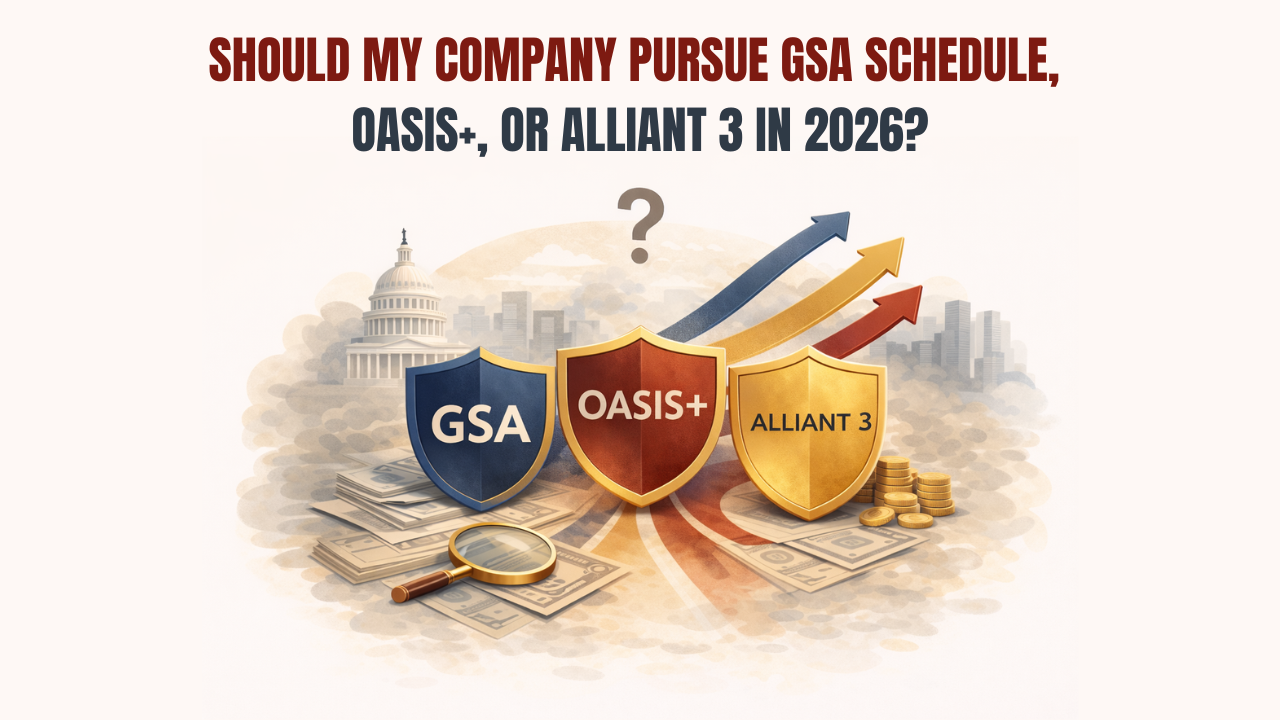
Federal buyers are consolidating procurement around a few high-impact contract vehicles. With momentum behind OASIS+ and Alliant 3, service firms are reassessing where to invest. The right choice depends on demand, timing, and how agencies actually buy your services.
What Is the Difference Between MAS, OASIS+, and Alliant 3?
MAS is a broad federal supply schedule for commercial products and services. OASIS+ is a multi-agency contract for complex professional services. Alliant 3 is a governmentwide acquisition contract focused on IT services.
MAS (GSA Schedule)
- Purpose: Flexible access to commercial products and services across government.
- Scope: Broad. Covers professional services, IT, facilities, and more.
- Access: Open to all federal agencies and many state and local entities.
- Best For: Firms seeking steady, decentralized opportunities and simplified acquisition.
OASIS+
- Purpose: Acquisition of complex professional services across multiple domains.
- Scope: Includes management consulting, engineering, R&D, logistics, and more.
- Structure: Multiple domains with small business set-asides.
- Best For: Firms targeting large, complex, multi-agency service requirements.
Alliant 3
- Purpose: Governmentwide acquisition contract for integrated IT services.
- Scope: Covers emerging technologies, cybersecurity, cloud, and enterprise IT.
- Structure: Focus on large-scale, mission-critical IT solutions.
- Best For: IT service providers pursuing high-value, long-term federal programs.
Why Do Companies Choose the Wrong Federal Contract Vehicle?
Many firms start with eligibility instead of demand. Winning contractors align their vehicle strategy with how agencies buy, not just where they qualify.
In practice, we see companies pursue vehicles simply because they can. This leads to inactive contracts, missed revenue targets, and wasted bid resources. A demand-driven approach evaluates:
- Buyer behavior: Which vehicles target agencies actually use.
- Domain alignment: Whether your services match the vehicle’s scope.
- Competitive density: Number and strength of existing contract holders.
- Timing: Current solicitation windows and award cycles.
- Sales readiness: Ability to market and capture task orders post-award.
Advisory Note: If you are unsure which vehicle aligns with your revenue goals, a structured go/no-go assessment can prevent costly missteps and accelerate market entry.
How Should Service Firms Evaluate Buyer Behavior and Timing?
Service firms should analyze where their target agencies are placing obligations and how upcoming awards will shift procurement patterns. Timing matters as much as eligibility.
Key evaluation steps:
- Map Agency Demand
- Identify top agencies buying your services.
- Determine which contract vehicles they prefer.
- Assess Domain Fit
- Align capabilities with OASIS+ domains or Alliant 3 IT scope.
- Validate past performance relevance.
- Evaluate Competitive Position
- Review incumbent contractors.
- Identify teaming or subcontracting pathways.
- Consider Procurement Timing
- Alliant 3 Phase I Notice to Proceed issued March 10, 2026.
- OASIS+ Phase II amendments finalized January 2026.
- MAS remains open continuously, offering immediate entry.
Why Are OASIS+ and Alliant 3 Changing the 2026 Federal Buying Landscape?
These vehicles support GSA’s procurement consolidation strategy, concentrating high-value service spending into fewer contract channels. This shift increases competition but also centralizes opportunity.
Agencies are increasingly directed to use Best-in-Class vehicles. OASIS+ and Alliant 3 both carry this designation, making them preferred options for:
- Large professional services programs
- Enterprise IT modernization
- Multi-agency task orders
- Strategic sourcing initiatives
For IT and professional services firms, this means:
- Greater visibility and credibility when on these vehicles
- Access to larger, more complex task orders
- Increased competition and higher proposal standards
Does a GSA Schedule Still Matter If I’m Targeting OASIS+ or Alliant 3?
A GSA Schedule remains a foundational contract vehicle that supports market entry, past performance development, and complementary sales channels.
Benefits of maintaining MAS alongside GWACs and MACs include:
- Speed to Market: Continuous onboarding allows immediate access to federal buyers.
- Past Performance: Strengthens qualifications for future GWAC pursuits.
- Flexibility: Supports smaller task orders and direct awards.
- State and Local Access: Expands market reach beyond federal agencies.
- Teaming Advantages: Positions your firm as a subcontractor to prime GWAC holders.
What Is the Difference Between Alliant 3 and MAS?
Alliant 3 is a specialized IT GWAC for large, integrated solutions, while MAS is a broad, flexible schedule covering a wide range of commercial services and products.
| Feature | MAS (GSA Schedule) | Alliant 3 |
|---|---|---|
| Scope | Broad commercial services and products | Integrated IT services |
| Contract Type | Federal Supply Schedule | GWAC |
| Entry Timing | Open continuously | Periodic on-ramps |
| Typical Deal Size | Small to mid-size | Large, enterprise-scale |
| Competition Level | Moderate | High |
| Best For | Market entry and diversified sales | Large IT program pursuits |
Which GSA Vehicle Is Best for IT Services?
The best vehicle depends on your growth strategy. MAS suits firms seeking flexibility and faster entry, while Alliant 3 is ideal for those targeting large-scale IT programs. Many firms benefit from holding both.
Can a Small Business Win with MAS If Agencies Are Using GWACs More Often?
MAS continues to generate billions in obligations annually, with strong small business participation and simplified acquisition pathways.
Small businesses succeed on MAS by:
- Targeting niche capabilities
- Leveraging set-aside opportunities
- Building direct relationships with agency buyers
- Using MAS as a subcontracting gateway to GWAC task orders
How Do I Choose the Right Federal Contract Vehicle?
Start with demand, align with your capabilities, and evaluate timing and competitive positioning. The optimal strategy often involves a phased approach rather than a single vehicle.
Our Approach
We guide firms through a structured decision framework:
- Demand Analysis: Identify where agencies are buying your services.
- Capability Alignment: Match offerings to vehicle scope and domains.
- Competitive Assessment: Evaluate win probability and differentiation.
- Timing Strategy: Sequence MAS, OASIS+, and Alliant 3 pursuits.
- Go/No-Go Decision: Prioritize investments that maximize ROI.
The Smarter Way to Handle This
Contract vehicle selection is not an administrative decision. It is a market positioning strategy. Firms that align with buyer behavior and procurement trends capture significantly more federal revenue than those that pursue vehicles based solely on eligibility.
Frequently Asked Questions
Should I get a GSA Schedule or pursue OASIS+ first?
If immediate market access is needed, start with MAS. Firms prepared for large, complex professional services contracts and aligned with current solicitation timing may prioritize OASIS+.
What is the difference between Alliant 3 and MAS?
Alliant 3 focuses exclusively on large-scale IT services through a GWAC structure, while MAS offers broad access to commercial services and products with faster entry.
Which GSA vehicle is best for IT services?
MAS is ideal for flexible and rapid entry, while Alliant 3 is best for firms pursuing enterprise-level IT programs. A dual-vehicle strategy is often optimal.
Can a small business win with MAS if agencies are using GWACs more often?
Yes. MAS remains a high-volume contracting channel with strong small business participation and accessible task order opportunities.
How do I choose the right federal contract vehicle?
Evaluate agency demand, capability fit, competition, and timing. A data-driven go/no-go assessment ensures the best return on investment.
Ready to Choose the Right Contract Vehicle for 2026?
Selecting between MAS, OASIS+, and Alliant 3 is a strategic investment decision. The wrong choice can delay growth and drain resources, while the right one positions your firm for sustained federal revenue.
We conduct in-depth vehicle strategy consultations and execute the acquisition process from start to finish. If you want clarity, speed, and a higher probability of award, we are ready to step in.