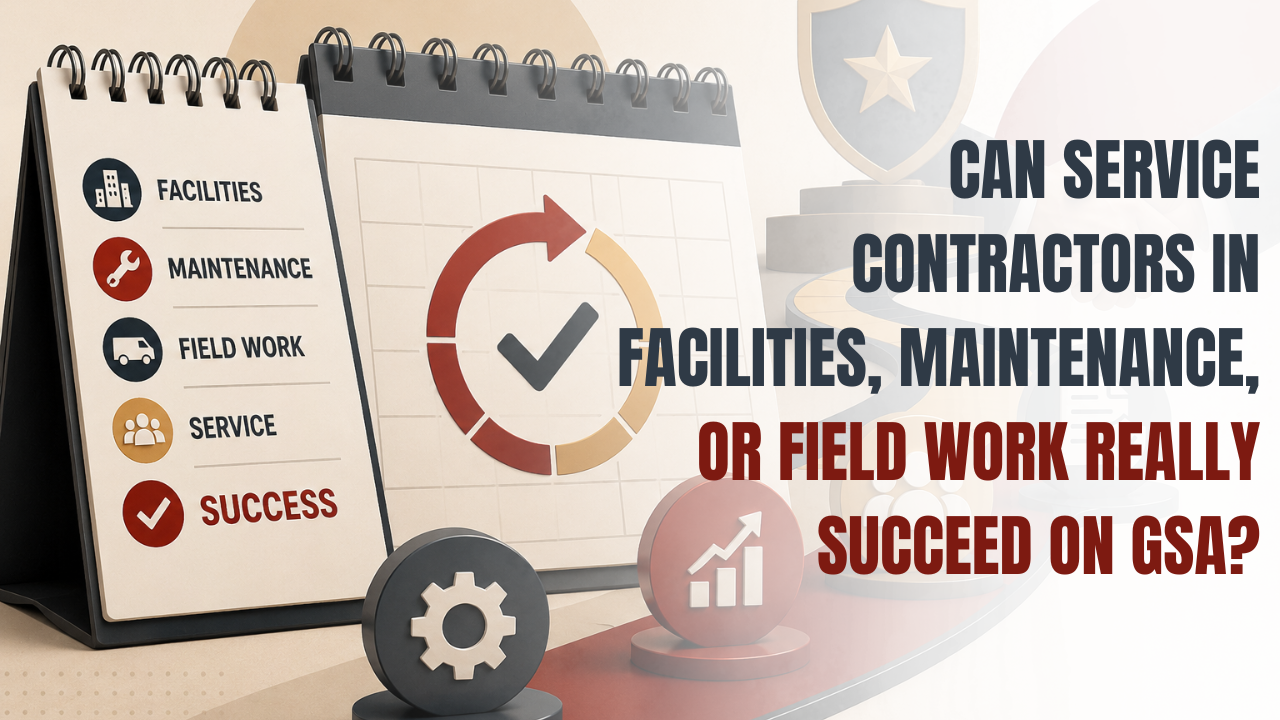
A GSA Schedule can work for service contractors in facilities, maintenance, repair, field operations, and related work, but only when the company has the right category fit, relevant experience, pricing discipline, and federal sales plan. MAS is not only for IT or product-heavy vendors. The challenge is that operational service companies usually need a more precise offer strategy than companies selling standard products or software.
Many service firms ask the wrong first question. They ask, “Can we get on GSA?” The better question is, “Can we win and perform through GSA in a way that supports our business model?”
Is MAS Only Useful For IT And Product Vendors?
No. MAS is not only useful for IT companies or product vendors. GSA’s Multiple Award Schedule includes commercial products, services, and solutions, and GSA specifically identifies facility-related services such as complete facility maintenance, custodial work, elevator preventive maintenance, grounds and landscaping, utility systems maintenance, refrigeration, air conditioning, ventilation, HVAC, and energy management support. (U.S. General Services Administration)
The misconception exists because the loudest GSA conversations right now often involve software, AI, cloud, cybersecurity, GWACs, and OneGov. GSA’s OneGov strategy is heavily associated with IT buying, and GSA has described it as a governmentwide approach to buying common IT needs through unified purchasing power and established vehicles such as MAS. (U.S. General Services Administration)
That does not mean facilities and operational services are irrelevant. It means service contractors have to understand where they fit.
Examples of MAS-relevant operational service categories can include:
- Facilities maintenance and management
- Building maintenance operations
- HVAC, plumbing, electrical, elevator, and fire suppression support
- Grounds and landscaping services
- Custodial and housekeeping-related services
- Equipment maintenance and repair
- Facility assessment and consulting
- Smart building systems integration
- Installation and site preparation when tied to eligible schedule scope
The opportunity is real. The strategy cannot be generic.
Can Facilities And Maintenance Contractors Get On A GSA Schedule?
Yes. Facilities and maintenance contractors can get on a GSA Schedule if their services align with the correct Special Item Numbers, they can document relevant experience, and they can support fair and reasonable pricing. For example, SIN 561210FAC covers services related to operations, maintenance, and repair of federal real property, including HVAC, electrical, plumbing, fire alarm and suppression, energy management control systems, waste management, recycling, and facilities consulting or assessment services.
For service contractors, eligibility is only the starting point. GSA will still look at whether the offer is structured clearly and whether the company can support the scope it wants awarded.
A facilities or maintenance company should be prepared to show:
- Relevant past performance: Work similar to the services being offered under the MAS contract.
- Clear service descriptions: Specific, commercially grounded descriptions that match the SIN scope.
- Labor category logic: Titles, duties, qualifications, and pricing that reflect how work is actually performed.
- Pricing support: Documentation that supports proposed rates or service pricing.
- Operational capacity: Evidence the company can manage federal work, field teams, compliance, and customer requirements.
- Contract administration readiness: Ability to maintain the contract after award, including modifications, sales reporting, and scope discipline.
This is where field-service companies often differ from IT companies. The offer is not just about uploading standard labor categories. It must translate real-world work into a federal contract structure that GSA can evaluate and agencies can buy from.
Is GSA Worth It For Facilities Or Maintenance Contractors?
GSA can be worth it for facilities and maintenance contractors when target agencies already buy similar services through MAS, the contractor has relevant experience, and the company has a realistic business development plan. It is usually not worth it if the company sees MAS as a shortcut around capture, local relationships, pricing discipline, or operational readiness.
The best candidates usually have at least some of the following:
- Existing public sector or federal experience
- Commercial past performance that maps cleanly to GSA SINs
- Repeatable services, not just one-off custom projects
- A pricing model that can survive federal scrutiny
- A clear geographic or agency target market
- Internal staff who can support contract administration
- A sales team willing to use the contract proactively
GSA is a contract vehicle. It does not create demand by itself. For a service contractor, the win comes from using the vehicle to reduce friction for buyers who already need the type of work you perform.
What Makes GSA Harder For Field-Service Contractors?
GSA is harder for field-service contractors because their work often depends on labor mix, geography, site conditions, equipment, response time, and performance risk. Product companies can often define fixed items. Field-service companies have to define services clearly enough for GSA to award and flexible enough for agencies to order.
The biggest challenges usually fall into four areas.
1. Scope Alignment
The company must match its services to the correct SIN. This is especially important in facilities and field work because some activities may look similar commercially but fall into different federal acquisition lanes.
Common scope questions include:
- Is the work facilities maintenance, repair, consulting, installation, or construction?
- Is it tied to real property?
- Is it recurring maintenance or project-based work?
- Does the SIN allow the full scope the company wants to sell?
- Are any services excluded or restricted?
2. Service Definition
Service firms often describe their work in broad language because commercial buyers already understand what they do. GSA needs more precision.
Weak description:
“We provide full-service maintenance support.”
Stronger description:
“We provide preventive and corrective maintenance services for facility systems, including scheduled inspections, troubleshooting, repair coordination, work order response, and documentation support for government-owned facilities.”
3. Labor And Pricing Discipline
Facilities and field-service work often includes technicians, supervisors, project managers, dispatch, quality control, travel, materials, subcontractors, and emergency response. If the pricing structure is unclear, the offer can become difficult to evaluate and even harder to manage after award.
4. Post-Award Execution
After award, the company has to keep the contract aligned with how it sells. That may include adding labor categories, updating service descriptions, adjusting rates through modifications, and ensuring awarded scope still matches actual opportunities.
If your service offering does not fit neatly into a product-style offer, CAP50’s federal market strategy support can help determine whether MAS is the right path before your team invests in a full application.
What Mistakes Do Service Firms Make When Applying For GSA?
The most common mistake is forcing a service business into a product-style submission strategy. Facilities, maintenance, and field-service contractors need to prove scope fit, experience relevance, pricing logic, and delivery readiness, not just submit generic descriptions and rate tables.
Common mistakes include:
- Using vague service descriptions: Broad descriptions make it harder for GSA to understand what is actually being offered.
- Choosing the wrong SIN: A poor category match can create review problems and future sales limitations.
- Ignoring exclusions: Some construction-related or real property work may require careful review before being positioned under MAS.
- Overloading the offer with labor categories: Too many categories can make the offer harder to defend if they are not tied to real work.
- Copying IT-style labor categories: Field-service roles need operational accuracy, not generic consultant language.
- Underestimating pricing support: GSA still needs to determine pricing is fair and reasonable.
- Failing to plan for modifications: Service contractors often need post-award updates as capabilities, geography, and pricing evolve.
- Assuming eligibility equals sales: Getting awarded does not replace agency targeting or capture activity.
A GSA offer should look like your business translated into a government contract format. It should not look like someone copied a template from a completely different industry.
How Should A Service Contractor Decide If MAS Is A Good Fit?
A service contractor should decide whether MAS is a good fit by evaluating category fit, buyer demand, past performance, pricing support, operational readiness, and business development capacity. Being eligible is not enough. The company needs to know whether the contract vehicle can realistically help it win work.
Use this assessment before moving forward:
- Confirm SIN fit.
Identify which SINs match your current services and which services may not belong on MAS. - Review agency buying behavior.
Look for whether your target agencies buy similar services through GSA Schedule, other IDIQs, BPAs, local contracts, or open-market procurements. - Map your past performance.
Match completed projects to the specific services you want to offer. - Pressure-test pricing.
Determine whether rates, labor categories, materials, travel, and subcontracting can be supported. - Define target buyers.
Identify agencies, installations, regions, or program offices that need your services. - Evaluate internal administration.
Decide who will manage modifications, sales reporting, renewals, and compliance. - Build a post-award sales plan.
A MAS contract should support capture. It should not be treated as the capture plan.
Why Does Centralized Buying Matter For Service Contractors?
Centralized buying matters because GSA is increasingly positioned as a central channel for common government purchases, shared services, and acquisition efficiency. Even though many current headlines focus on IT, the broader movement toward category management and procurement consolidation affects how contractors should think about contract vehicles, buyer access, and market positioning.
GSA describes category management as buying common goods and services as an organized enterprise to improve acquisition efficiency and effectiveness, including areas such as housekeeping services. GSA also states that category management helps the government buy like an enterprise by using spend categories, data, supplier management, and demand management.
In 2026, GSA also described new acquisition shared services work intended to coordinate procurement systems, business standards, shared services, provider performance, and demand consolidation where appropriate.
For service contractors, the takeaway is not, “Everyone needs a Schedule.” The takeaway is more precise:
- Agencies are under pressure to buy more efficiently.
- Contract vehicles matter because they reduce acquisition friction.
- Category fit matters because buyers are organizing spend more intentionally.
- Service contractors need to show up where buyers are actually buying.
- GSA can be useful when it aligns with a real market path.
If your company performs recurring operational work, MAS may help you access buyers who prefer existing government contract vehicles. If your work is highly local, construction-heavy, or not commonly purchased through MAS, another path may be more practical.
Consultant’s View
The biggest mistake I see service contractors make is assuming GSA works the same way for every industry. It does not. A product reseller, software company, facilities firm, and field-service contractor may all use MAS, but the offer strategy, pricing logic, past performance story, and post-award sales motion are completely different.
For facilities and maintenance companies, the question is rarely “Can you apply?” The real question is whether the Schedule will support how you actually win and perform work. If the answer is yes, MAS can be a strong tool. If the answer is unclear, a fit assessment should come before the application.
What Should A Facilities Or Field-Service MAS Strategy Include?
A strong MAS strategy for a facilities or field-service contractor should include a fit assessment, SIN strategy, experience mapping, pricing plan, labor category structure, service description framework, and post-award sales plan. The goal is to build a contract that agencies can buy from and the contractor can actually use.
At a minimum, your strategy should cover:
- Category and SIN fit: Which parts of your work belong on MAS, and which do not.
- Service packaging: How your services will be described, ordered, and priced.
- Labor category design: Which roles are needed and how they support delivery.
- Geographic considerations: Whether your service area affects pricing, response time, staffing, or buyer targeting.
- Relevant experience: Which projects prove capability for the offered scope.
- Buyer demand: Which agencies, regions, or facilities have realistic need.
- Sales motion: How your team will use eBuy, agency outreach, teaming, and incumbent intelligence.
- Post-award maintenance: How the contract will be updated as rates, services, and capabilities evolve.
This is where GSA Verticalization™ becomes practical. The goal is not just to get awarded. The goal is to connect contract structure, compliance, pricing, agency targeting, and sales execution so the Schedule becomes part of the company’s growth infrastructure.
FAQs
Is GSA Worth It For Facilities Or Maintenance Contractors?
GSA can be worth it for facilities or maintenance contractors when their services fit a MAS SIN, target agencies use GSA for similar work, and the company has a realistic business development plan. It is less likely to be worth it if the company expects the contract to generate sales without active capture.
Can Field-Service Companies Get On A GSA Schedule?
Yes. Field-service companies can get on a GSA Schedule when their services align with MAS scope and they can support experience, pricing, and delivery readiness. The offer must translate field work into clear service descriptions, labor categories, and pricing structures GSA can evaluate.
Is MAS Only Useful For IT And Product Vendors?
No. MAS includes commercial products, services, and solutions, including facility-related services. The reason IT gets more attention is that current policy conversations around OneGov, AI, and software are very visible, but operational service companies can still have a viable MAS path when the fit is right. (U.S. General Services Administration)
What Are The Biggest GSA Challenges For Service Contractors?
The biggest GSA challenges for service contractors are scope alignment, service definition, labor category design, pricing support, and post-award execution. These issues are harder for field-service firms because work often varies by location, site condition, labor mix, equipment, and response requirements.
How Do Operational Service Firms Know If MAS Is A Good Fit?
Operational service firms should evaluate MAS fit by reviewing SIN alignment, buyer demand, past performance, pricing support, internal contract administration, and post-award sales capacity. The best assessment looks beyond eligibility and asks whether the company can realistically win and deliver through the vehicle.
Know Whether MAS Is Worth The Investment Before You Apply
For facilities, maintenance, and field-service contractors, the wrong GSA decision can waste months of effort and leave you with a contract your team does not know how to use. The right decision starts with a practical fit assessment: scope, buyer demand, pricing, experience, and post-award execution.
CAP50 helps service contractors determine whether MAS is truly viable before they invest in the application. If it is a fit, we help build the acquisition strategy, offer structure, and federal market plan around how your company actually sells and performs.
→ Start Your GSA Strategy With CAP50
A stronger federal strategy starts with knowing whether the vehicle matches the busines