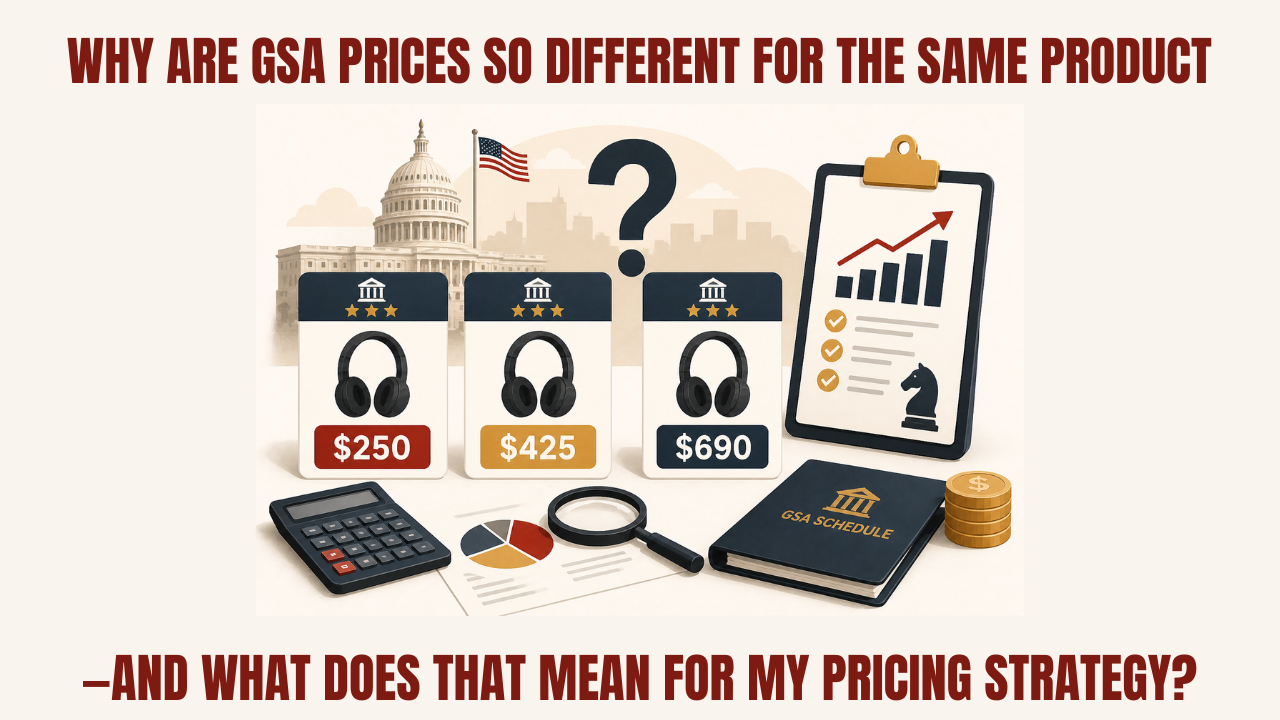
GSA pricing strategy in 2026 operates under universal Transactional Data Reporting following MAS Refresh 31, which removed Commercial Sales Practices disclosures and the traditional Price Reductions Clause structure. Yet identical or near-identical products still appear on Multiple Award Schedule contracts at materially different prices. That variability is no longer just a curiosity. It is now a competitive signal and a data-driven scrutiny risk.
If you are building or modifying a GSA Schedule today, your pricing must survive competitive comparison and transactional visibility. Approval is no longer the finish line. Defensibility is.
Why Are Prices Different Across GSA Contractors for Similar Items?
GSA prices differ because contractors have different cost structures, commercial positioning, margin strategies, and negotiation outcomes.
Even under universal TDR, variability enters through:
- Different cost bases such as OEM pricing tiers or labor burdens
- Different strategic positioning such as premium support versus volume reseller
- Different internal margin logic across product families
- Different negotiation dynamics with Contracting Officers
- Different SIN structuring decisions
Two vendors can list the same OEM product and still arrive at different awarded prices because their internal economics and market strategy differ.
GSA does not impose uniform pricing across contractors. It determines price reasonableness at award and ordering activities determine fair and reasonable pricing at the task or delivery order level under FAR 8.405.
Variability is allowed. Arbitrary pricing is not.
Why Does GSA Price Variability Matter More After Refresh 31?
It matters more because data visibility has increased.
In early 2026, the GSA Office of Inspector General raised concerns about price variability within MAS and whether agencies were consistently achieving best value. Refresh 31 intensified the data environment by removing Commercial Sales Practices disclosures and standardizing Transactional Data Reporting across SINs.
That changes the environment in three ways:
- Transaction-level visibility increases
- Comparative analytics become easier
- Outliers stand out faster
Under universal TDR, your pricing patterns are more visible than your disclosure narratives ever were.
Defensibility now depends on structural consistency.
How Does GSA Decide If My Prices Are Fair And Reasonable Under Universal TDR?
GSA evaluates pricing using FAR 15.404-1 price analysis techniques adapted for commercial acquisitions and supported by market comparisons and transactional data.
With Commercial Sales Practices removed under Refresh 31, evaluation no longer centers on Most Favored Customer relationships or Basis of Award tracking under GSAR 552.238-81. Instead, Contracting Officers rely on:
- Competitive comparisons within the applicable SIN
- Historical transactional data
- Commercial price lists and supporting documentation
- Negotiation memoranda documenting price analysis
The shift is significant.
Previously, contractors defended pricing through disclosure logic. Now they defend pricing through market logic and internal consistency.
Here is the structural difference:
| Pre-Refresh 31 Model | Post-Refresh 31 Model | Strategic Impact |
|---|---|---|
| CSP disclosures required | CSP removed | Less disclosure burden at award |
| Price Reductions Clause tracking | No PRC tracking | Lower administrative complexity |
| Limited post-award pricing visibility | Transactional reporting required | Higher comparative scrutiny |
The compliance burden shifted from discount tracking to data transparency.
Should I Just Lower My GSA Prices To Avoid Standing Out?
No. Lower is not automatically safer.
Underpricing creates three serious risks:
- Margin compression that makes federal delivery unsustainable
- Internal inconsistency across similar products or labor categories
- Market signaling erosion that undermines perceived value
Transactional data does not punish higher prices. It punishes illogical pricing.
If your product is priced 18 percent above the median but your support bundle, warranty, or service integration justifies it, that is defensible. If your pricing appears random compared to similar offerings, that is risky.
Pricing must be coherent.
What Makes Pricing “Audit-Ready” Under Universal TDR?
Audit-ready pricing is structurally consistent, benchmarked against the market, and documented internally.
The distinction looks like this:
| Reactive Pricing | Structured Pricing | Risk Profile |
|---|---|---|
| Matches lowest visible competitor | Aligned to internal cost logic | Low if consistent |
| Inconsistent margins across products | Normalized margin tiers | High if inconsistent |
| No benchmarking documentation | Documented competitive analysis | Moderate to low |
Competitive pricing wins orders. Structured pricing protects contracts.
You need both.
What Is A Practical Framework For A Defensible MAS Pricing Strategy?
A defensible pricing strategy follows four phases: benchmark, justify, normalize, document.
1. Benchmark
Compare:
- GSA Advantage listings under your SIN
- Competitors in GSA eLibrary
- Order-level data where accessible
- Your own commercial price bands
You are not chasing the lowest number. You are understanding the spread.
2. Justify
Define your position:
- Premium support model
- Mid-market scalability
- Volume-driven reseller strategy
Your positioning must align with internal cost structure.
3. Normalize
Ensure internal consistency:
- Similar products follow similar margin logic
- Labor categories reflect credential differentials
- OEM passthrough pricing is structured consistently
Normalization prevents internal contradictions that become visible in transactional reporting.
4. Document
Maintain:
- Market benchmarking analysis
- Pricing rationale memoranda
- Transactional reporting controls
- Negotiation support documentation
Documentation is what makes a future Contractor Assessment manageable instead of disruptive.
If you are preparing a new offer or major pricing modification, our GSA Schedule application team builds pricing packages aligned to the universal TDR environment from day one.
How Does Universal TDR Change Long-Term Pricing Risk?
Universal TDR reduces administrative complexity but increases comparative exposure.
Three structural shifts matter:
- No Basis of Award tracking
- No Price Reductions Clause monitoring
- Greater transaction-level analytics
The risk has moved from discount compliance to data coherence.
Patterns matter more than paperwork.
Our Take
The old advice was simple. Price low enough to get awarded.
That advice does not hold in 2026.
The smarter approach is structural pricing that aligns competitive positioning, internal economics, and long-term reporting logic. That alignment is part of how we apply GSA Verticalization™. Strategy, compliance, and growth cannot operate separately.
Pricing that wins without structure eventually creates friction. Pricing built on structure scales.
Frequently Asked Questions
Did Refresh 31 Remove Commercial Sales Practices?
Yes. MAS Refresh 31 eliminated Commercial Sales Practices disclosures and standardized Transactional Data Reporting across SINs.
Is The Price Reductions Clause Still Applicable?
No. With the removal of CSP disclosures, traditional Price Reductions Clause tracking under GSAR 552.238-81 no longer applies to MAS contracts operating under universal TDR.
Does TDR Make Pricing Less Risky?
It reduces disclosure complexity but increases transactional visibility. Risk shifts from discount tracking to pricing consistency.
Why Do Identical Products Still Have Different GSA Prices?
Because contractors have different cost structures, strategic positioning, and negotiation outcomes. GSA does not mandate uniform pricing.
How Do I Make My Pricing Defensible In 2026?
Benchmark competitors, align pricing with internal cost logic, normalize margins, and document your rationale. Competitive and defensible pricing must coexist.
Apply FAQPage schema.
Ready To Build A Pricing Strategy That Holds Up Under Universal TDR?
If you are preparing a new MAS offer or modifying pricing after Refresh 31, this is not the time for guesswork. Transactional data visibility means inconsistencies surface faster.
We build pricing strategies that align negotiation logic, competitive positioning, and long-term defensibility.
→ Start Your GSA Strategy With CAP50
The right pricing structure protects both your margin and your contract.