A founder sent the same glossy company overview to twelve contracting officers and heard nothing back. The document was beautiful. It was also the wrong document. Contracting officers do not read brochures. They scan capability statements, and they decide in seconds whether you are worth a conversation.
A capability statement is a one-page federal sales document that tells a government buyer exactly what you do, who you are in their system, and why you can be trusted to deliver. It is not a brochure and not an “about us” page. In 2026, with buyers running market research through SAM.gov and GSA eLibrary, a capability statement that still references a DUNS number instead of a UEI signals you are out of date before they read a word.
What Is a Capability Statement, and What Is It Not?
A capability statement is a concise, targeted one-pager built for federal buyers conducting market research. It exists to get you shortlisted, not to tell your whole company story.
The distinction that trips people up:
- It is a sales tool, not a marketing brochure. Every line answers a buyer’s question, not a marketing goal.
- It is targeted, not general. The strongest versions are tailored to a specific agency or opportunity, not one document sent to everyone.
- It is scannable, not comprehensive. A buyer should grasp who you are in fifteen seconds. Density beats completeness.
- It is current, not evergreen. Identifiers, codes, and contract vehicles change, and a stale statement reads as a stale company.
If your capability statement could double as your website’s homepage copy, it is a brochure wearing the wrong label.
What Are the Required Elements of a Capability Statement?
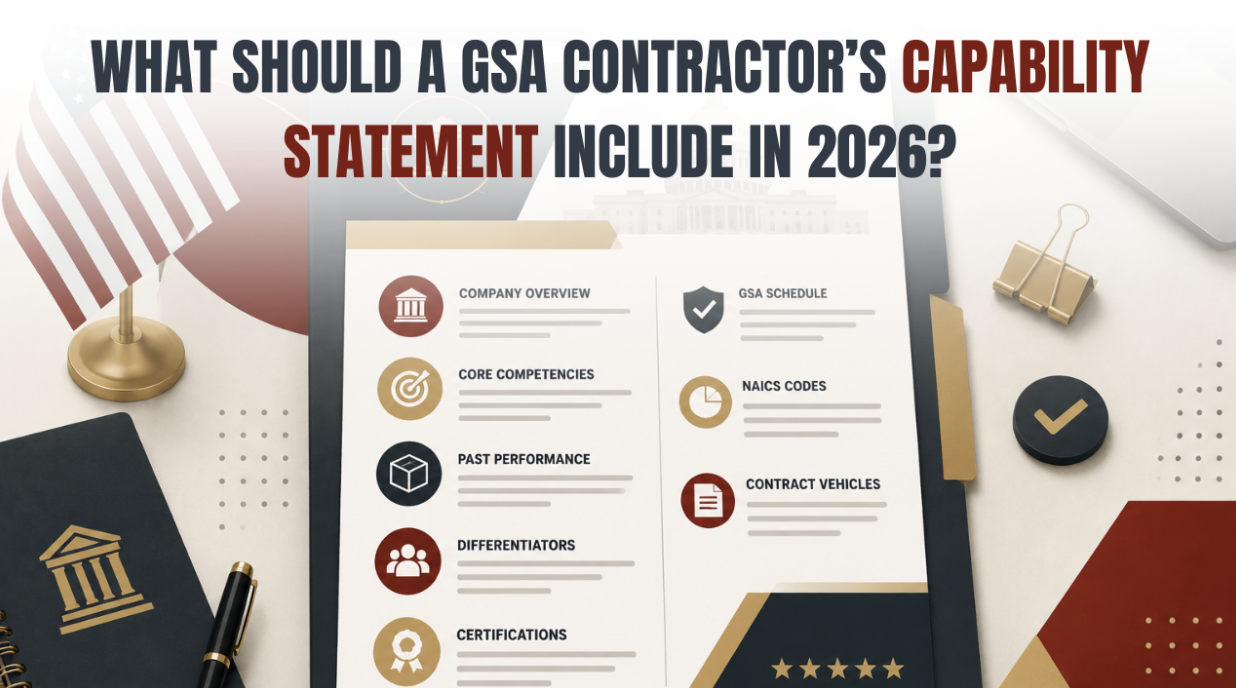
A federal capability statement should include a core set of elements that buyers look for: core competencies, differentiators, past performance, and your company data with current identifiers. Missing any of them weakens the document.
The standard components:
- Core competencies. A tight list of what you actually do, in the buyer’s language, mapped to the work they buy.
- Differentiators. Why you over the next vendor: specific capabilities, certifications, niche expertise, not slogans.
- Past performance. Relevant contracts and clients, ideally federal, with enough detail to be credible.
- Company data. Legal name, UEI, CAGE code, relevant NAICS codes, socioeconomic certifications, GSA contract number if you hold one, and current contact information.
- Contract vehicles. Your GSA Schedule and any other vehicles, so buyers know how they can actually purchase from you.
Notice what carries the most weight: past performance and differentiators. Those are what separate a vendor a CO will call from one they will skip.
If your past performance is thin or your differentiators read like every competitor’s, that is the real gap, and a federal market review helps you sharpen what actually makes a buyer choose you.
Why Does a GSA Contractor’s Version Differ From a Generic One?
Because GSA contractors have something most vendors do not, a Schedule, and the capability statement should make that immediately usable to a buyer. A generic statement wastes that advantage.
What a GSA-specific version does differently:
- Leads with the Schedule. Your GSA contract number and SINs tell a buyer they can purchase from you through a vehicle they already trust, which lowers their risk.
- Maps competencies to SINs. Buyers searching GSA Advantage and eLibrary think in SINs and categories; meeting them there makes you findable and credible.
- Connects to how GSA buyers buy. References to eBuy, GSA Advantage, and set-aside eligibility tell the buyer the exact path to an order.
- Reinforces compliance credibility. Holding and actively managing a Schedule is itself a trust signal worth surfacing.
A GSA Schedule is a buying advantage. A capability statement that hides it behind generic marketing throws that advantage away.
What Is the UEI Update Most Contractors Still Have Not Made?
The federal government replaced the DUNS number with the Unique Entity Identifier (UEI), and any capability statement still listing a DUNS number is visibly outdated. Buyers conducting market research in SAM.gov work from your UEI.
Why this small thing matters more than it looks:
- DUNS is gone from federal use. The UEI is the identifier in SAM.gov and across the award systems.
- Buyers verify you by UEI. When a CO researches you in SAM.gov or eLibrary, the UEI is the key. A document without it adds friction.
- A DUNS reference dates you instantly. It tells a sophisticated buyer your materials, and maybe your federal operation, have not been updated recently.
- Identifier hygiene is part of trust. With FPDS and eSRS now folded into SAM.gov, accurate, current identifiers matter more across the board.
Updating DUNS to UEI is a five-minute fix that quietly removes a reason for a buyer to pass.
Our Take
The capability statement is the most underestimated document in federal contracting. Contractors pour money into a website almost no contracting officer will visit and then hand a buyer a brochure that answers none of the questions a buyer actually asks. The fix is not design; it is discipline. One page, buyer language, real past performance, current identifiers, and the Schedule out front. In 2026, with buyers doing pre-solicitation research in SAM.gov and eLibrary, the capability statement is often the first and only impression you control. Treat it as the targeted sales tool it is, not a marketing afterthought, and it does what GSA Verticalization™ is meant to do: turn a credential into actual pipeline.
Frequently Asked Questions
What should be included in a capability statement for GSA contractors? Core competencies, differentiators, past performance, and company data including your UEI, CAGE code, NAICS codes, socioeconomic certifications, GSA contract number, and SINs. GSA contractors should lead with their Schedule so buyers know how to purchase.
How is a federal capability statement different from a company brochure? A brochure markets your company broadly. A capability statement is a targeted, scannable one-page sales tool built for a federal buyer doing market research, focused on what you do, your differentiators, your past performance, and how they can buy from you.
Does my capability statement need a UEI instead of a DUNS number? Yes. The federal government replaced DUNS with the Unique Entity Identifier (UEI). A capability statement still listing a DUNS number is outdated, and buyers verify you by UEI in SAM.gov.
How long should a federal capability statement be? One page is the standard. Buyers scan it quickly during market research, so density and clarity matter more than length.
How do I get my capability statement in front of contracting officers? Tailor it to the agency or opportunity, lead with your GSA Schedule and SINs so you are findable in GSA Advantage and eLibrary, and pair it with targeted outreach. A generic statement sent to everyone rarely lands.
Make Your One-Pager Earn the Meeting
A capability statement is the smallest document in your federal toolkit and one of the most decisive. When a contracting officer is deciding whether you are worth a call, this is what they are looking at, and a brochure with a dead DUNS number is an easy no.
A federal market review sharpens your competencies and differentiators, makes sure your Schedule and current identifiers lead, and turns a generic one-pager into a targeted tool that gets you shortlisted.
→ Start Your Capability Statement Review
The bigger firms have a polished one ready for every agency. This is how you close that gap in one conversation.