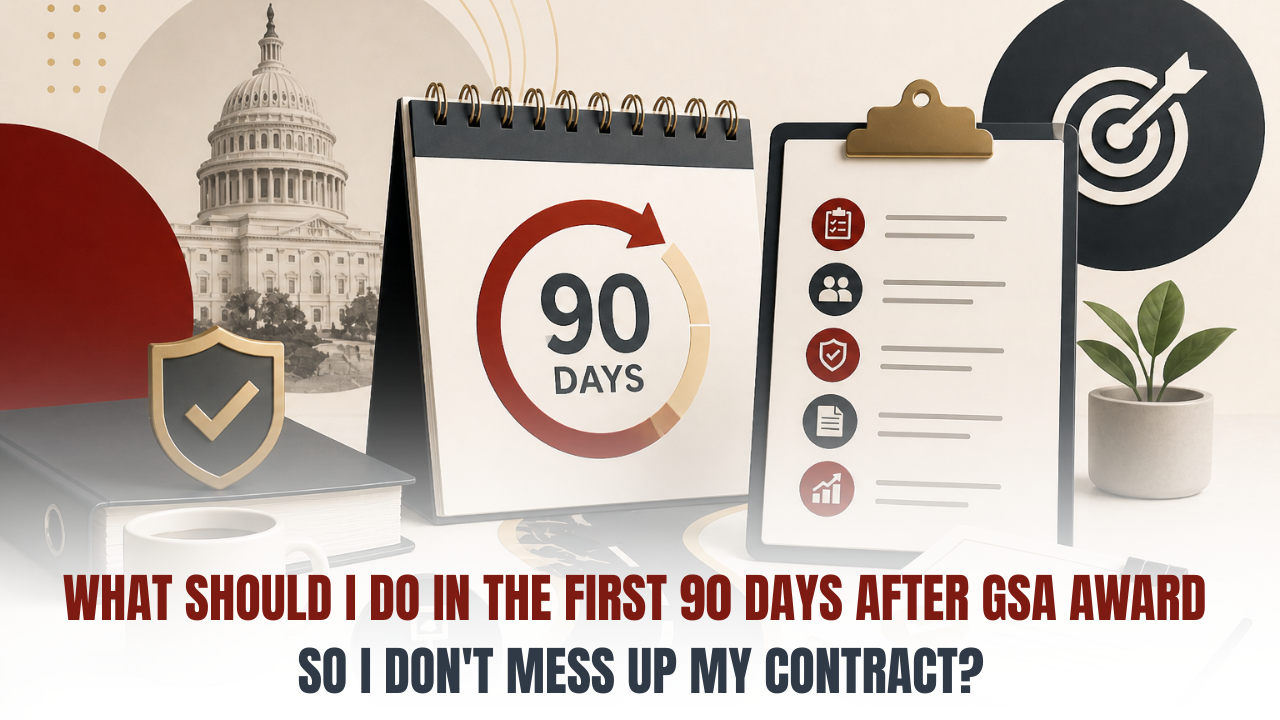
The first 90 days after your GSA Schedule award are the foundation of a 20-year contract. In this window, new MAS holders must register with the Vendor Support Center, upload their electronic catalog to GSA Advantage!, set up a FAS ID for sales reporting, designate a Mass Mod point of contact, and build the internal systems that keep the contract compliant. Skipping any of these steps puts the contract at risk before a single order arrives.
Award day feels like the finish line. It isn’t. It’s the starting gun on a multi-year compliance program GSA expects you to run without much hand-holding. The Industrial Operations Analyst (IOA) assigned to your contract will check on you, but the burden of getting the systems right sits with you. New holders who treat the post-award period like a victory lap usually discover their first compliance gap during their first IOA review or their first Mass Mod deadline. By then, fixing it costs real time and real credibility.
Why Do the First 90 Days After GSA Award Matter So Much?
They matter because GSA enforces specific deadlines that begin the day your contract is signed, and missing them creates a paper trail of non-compliance that follows your contract through every option renewal.
Within the first 30 days you owe GSA a published catalog on GSA Advantage!. Within 90 days of any Mass Mod release, you owe a response. Within the first quarter of sales activity, you owe a sales report and an Industrial Funding Fee (IFF) payment. None of these wait for your team to be ready. The contract clock and the GSA system clock run on their own.
Beyond the deadlines, the first 90 days are when you build (or fail to build) the four operational systems every successful Schedule holder needs:
- A sales segregation system that separates GSA-authorized orders from commercial and open-market sales at the invoice level.
- A pricing compliance system that tracks your Basis of Award (BOA) customer or, for TDR contracts, your transactional data feed.
- A Mass Mod monitoring system so amendments to the MAS Solicitation get accepted on time.
- A modification (eMod) workflow for the catalog, pricing, and POC changes that will inevitably come.
Build these in the first 90 days or rebuild them under audit pressure later.
What Must You Do in Days 1 to 30 After GSA Award?
In the first 30 days, register your contract on the Vendor Support Center, upload your electronic contract data to GSA Advantage!, register for a FAS ID, and confirm your authorized negotiator and contract POCs are correct.
Specifically:
- Register with the Vendor Support Center (VSC). The VSC is the central hub for new contractors. Download the Contractor Start-up Kit. It is the closest thing GSA has to a manual.
- Upload electronic contract data to GSA Advantage! within 30 calendar days of award. Use the Schedule Input Program (SIP) unless GSA has notified you that you are eligible for the Formatted Catalog Process (FCP). Until your catalog is live, you are awarded but invisible to federal buyers.
- Register for a FAS ID to access the FAS Sales Reporting Portal (SRP). This is where you will report sales (quarterly, or monthly for TDR contracts) and remit the 0.75% Industrial Funding Fee.
- Verify your contract POCs in the system: authorized negotiator, contract administrator, ordering POC, and (if applicable) subcontracting POC. Mass Mod notifications go to the negotiator’s email. Wrong email equals missed deadline equals non-compliance.
- Identify your Industrial Operations Analyst (IOA). GSA assigns one to your contract after award. Find them, introduce yourself, and treat that relationship as ongoing.
If your contract was awarded with a complex catalog, eMod activity will dominate days 1 to 30 just to get your offerings listed correctly. Plan for it.
What Should You Do in Days 31 to 60 After GSA Award?
In days 31 to 60, build the internal systems that keep your contract compliant for the long haul: sales segregation, pricing compliance, Trade Agreements Act tracking, and Mass Mod monitoring.
This is where most new holders go wrong. The first 30 days are about GSA’s deadlines. The next 30 are about your operations.
- Set up GSA sales segregation in your accounting system. Every GSA-authorized order needs to be tagged separately from commercial and open-market sales. Mixed reporting is one of the most common audit findings. Get the tagging right at invoice creation, not in a quarterly scramble.
- Document your Basis of Award (BOA) customer or class if your contract is not under Transactional Data Reporting (TDR). The Price Reductions Clause requires you to report any change in discounts to that BOA customer to your Contracting Officer. Most contractors don’t realize their internal sales team can trigger a Price Reductions issue without anyone telling GSA.
- For TDR contracts, configure your monthly transactional data report. TDR contractors report by line item and by transaction. Set this up once, correctly, and it runs.
- Verify Trade Agreements Act (TAA) compliance. Every product on your Schedule must be made or substantially transformed in a TAA-designated country. If your supply chain shifts, and supply chains shift, you need a process that catches it.
- Configure Mass Mod monitoring. Mass Mods are GSA-issued amendments to the MAS Solicitation that contractors must accept within 90 days of release. At least two people on your team should see the notifications, and one should own the response.
- Activate eBuy access so RFQs filtered to your awarded SINs start landing in your inbox.
If your post-award setup needs a senior set of eyes before your first IOA review, our GSA Schedule management team can run a full diagnostic in two weeks and flag gaps before they become findings.
What Should You Do in Days 61 to 90 After GSA Award?
In days 61 to 90, run your first end-to-end test of the systems you built, finalize your federal go-to-market plan, and prepare for your first sales reporting cycle.
By day 60, the systems should exist. By day 90, you should have proven they work.
- Run a sales reporting dry run. If a federal order came in tomorrow, could your team capture it, segregate it, report it through the SRP, and remit the IFF correctly? Test the workflow against a sample transaction before a real one tests it for you.
- Confirm your GSA Advantage! catalog is live, accurate, and searchable. Pull up your own listings. Check pricing, descriptions, photos, and SIN assignments. Buyers search GSA Advantage! the way they search Amazon. Bad listings mean no orders.
- Build your federal go-to-market plan. A Schedule does not generate sales. You generate sales. Identify three to five target agencies whose mission and buying patterns match your offerings. Build a target opportunity list from USASpending.gov, FPDS.gov, and GSA eBuy. Capitol 50’s GSA Verticalization™ approach starts here: pick the verticals where your capabilities have a real shot, and concentrate.
- Audit your prices against your commercial Most Favored Customer. If your commercial pricing has shifted since proposal submission, you may already owe a Price Reductions disclosure.
- Prepare for the new minimum sales requirement. This one trips up almost every new holder.
How Has the Minimum Sales Requirement Changed for New GSA Awardees?
The minimum sales requirement was amended in 2024. New awardees must now generate $100,000 in GSA sales over the five-year base period and $125,000 in each subsequent five-year option period, replacing the older $25,000-in-24-months rule under clause I-FSS-639.
This is the single biggest recent change new holders need to understand. The old rule pressured contractors to produce $25,000 in sales within 24 months of award. The amended rule extends that runway to a full five years but raises the dollar bar significantly. GSA is enforcing the new threshold at option exercise rather than annually, but enforcement is real: under the current cost-cutting environment, contracts that miss the threshold are not seeing options renewed.The practical implication for the first 90 days: your federal sales plan needs to target enough revenue to clear $100,000 in five years. For most contractors, that means closing one to three federal orders per year, sustained.
| Rule version | Threshold | Period | Enforcement trigger |
|---|---|---|---|
| Pre-2024 | $25,000 | First 24 months, then $25,000 each year | Cancellation under GSAR 552.238-73 |
| 2024 amendment (current) | $100,000 base, $125,000 per option period | First 60 months, then each 60-month option | Option not exercised at renewal |
What Are the Most Common Mistakes New GSA Holders Make in the First 90 Days?
The most common mistakes are missing the 30-day catalog upload, neglecting Mass Mod notifications, mixing GSA and commercial sales in one general ledger, and treating the Schedule as a sales channel instead of a contract that requires active management.
Specific patterns we see:
- The awardee does not check the authorized negotiator email regularly. A Mass Mod hits day 35. By day 125 it has expired and the contract is non-compliant.
- The awardee uploads the catalog to GSA Advantage! late. Buyers can’t find them. Sales never start. The clock to the first option renewal review keeps ticking.
- The awardee assumes IFF only applies after the first big sale. They miss the quarterly reporting deadline even on $0 sales (you still report $0).
- The awardee does not set up sales segregation. By the time the IOA visits, the team is reverse-engineering 18 months of invoices to figure out what was a GSA sale.
- The awardee builds no federal pipeline. The Schedule sits, the five-year clock runs, and the $100,000 minimum becomes mathematically impossible.
Our Take
A GSA Schedule is a 20-year asset, but only if the first 90 days are treated like the foundation of a 20-year asset. Capitol 50’s GSA Verticalization™ approach moves new holders from awarded to actually winning by mapping the operational, compliance, and growth systems together from day one. The contractors who struggle in year three almost always made their mistakes in week two. The fix is a structured first 90 days, not a heroic year three recovery.
Frequently Asked Questions
How long do I have to upload my catalog to GSA Advantage! after award? Electronic contract data must be submitted within 30 calendar days of award per GSA guidance. The full catalog with all required fields should be live as quickly as possible after that. Late upload means lost visibility to federal buyers and a flag for IOA reviews.
What is the FAS ID and why do I need it in the first 30 days? The FAS ID is your login credential for the FAS Sales Reporting Portal, where you report sales and remit the 0.75% Industrial Funding Fee. You need it set up before your first reporting period closes, even if you have $0 in sales (which still requires a $0 report).
What happens if I miss a Mass Mod deadline? Mass Mods must be accepted within 90 days of release. Missing the deadline puts your contract out of compliance with the current MAS Solicitation, can hold up future modifications you submit, and creates a finding on your contract record that follows you to option renewal.
Do I have to make $25,000 in sales in my first 24 months? No. The minimum sales requirement was amended in 2024. New awardees must now hit $100,000 in cumulative GSA sales over the five-year base period and $125,000 in each subsequent option period. The 24-month rule no longer applies, but enforcement of the new threshold at option renewal is active.
Who is my Industrial Operations Analyst and when will I hear from them? GSA assigns an IOA to your contract after award. They will contact you for an introductory Contractor Assistance Visit, typically within the first year. You can find their contact information in your contract documents and through the VSC. Don’t wait for the visit. Reach out, introduce your team, and use them as a resource.
Start Your First 90 Days With a Senior GSA Operator on Your Side
Most new GSA holders don’t fail because the work is impossible. They fail because nobody told them which day-30, day-60, and day-90 actions actually matter. Capitol 50’s team has guided contractors through the post-award window for two decades. We can help you stand up your sales reporting, Mass Mod monitoring, and federal pipeline before your first IOA visit, not after.
→ Start Your GSA Strategy With CAP50
A 30-minute call now is the cheapest way to protect a 20-year contract.