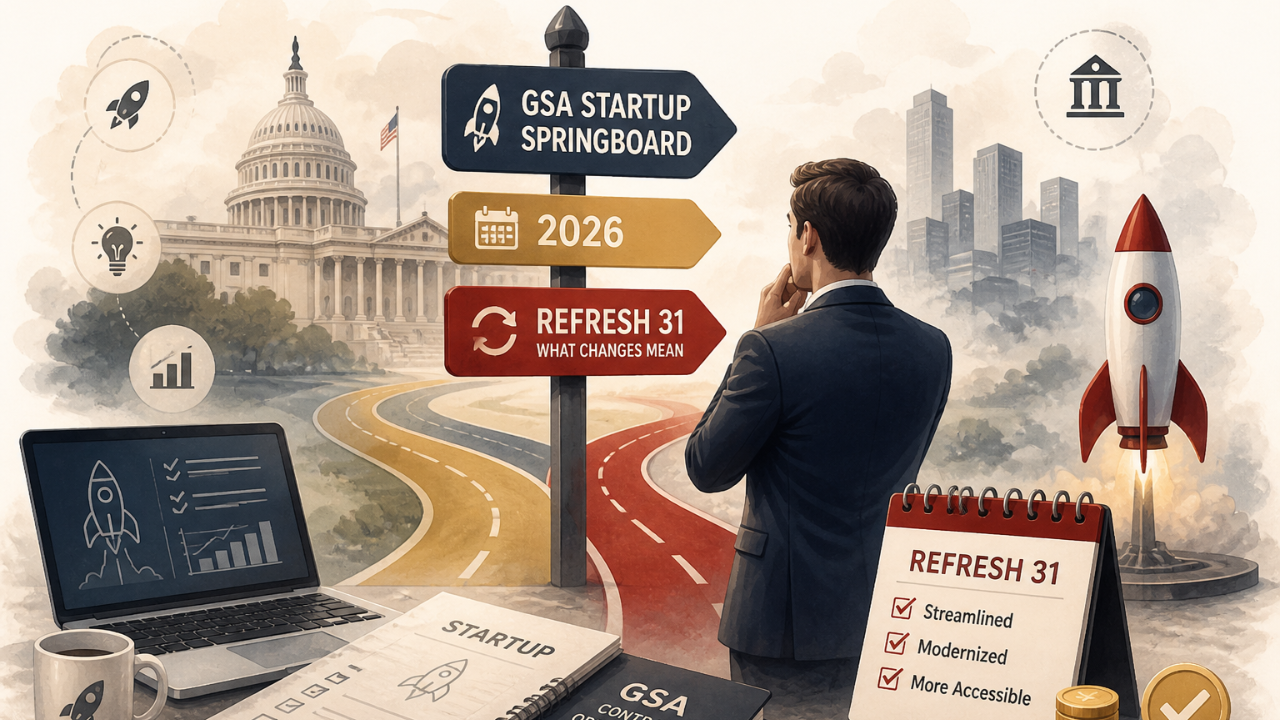
If you run an emerging tech company and you’ve been planning a GSA Schedule submission through Startup Springboard, the door just got narrower. Refresh 31 landed on April 2, 2026, and it tied Springboard eligibility directly to FASt Lane, which only opens to offers under the IT Category. For non-IT startups, the practical answer is that this pathway is closed. For IT vendors with the right agency relationship, it’s still on the table, but the bar is higher and the timeline is unforgiving.
Is GSA Startup Springboard still available in 2026?
Yes, but only for IT-category offerors who qualify under the GSA FASt Lane program. After Refresh 31, Startup Springboard is no longer open to startups across all Large Categories. Any company outside the Information Technology Category cannot use this pathway to bypass the two-year corporate experience requirement.
This is a meaningful reversal. Springboard originally launched in 2016 under IT Schedule 70, then expanded to every Large Category so any new company with strong leadership experience could compete. Refresh 31 pulls it back to its IT-only roots. If your business sells professional services, office products, facilities work, or anything outside ITC, Springboard is no longer your route in.
What did Startup Springboard originally do for early-stage companies?
Startup Springboard was built to waive the standard two-year corporate experience requirement under the GSA Multiple Award Schedule. It allowed early-stage firms to use the past performance of their executives and key personnel in place of a full company track record. That alone opened the federal supply schedule to younger firms with strong capability but a thin corporate history.
It was never a free pass. Even under the old rules, applicants still had to show:
- Financial documentation proving they could perform.
- Past performance, whether at the corporate or executive level.
- Pricing support and commercial invoicing history.
- Adequate staffing and resources to deliver.
- Compliance with TAA and standard MAS terms.
The waiver was about corporate age. Everything else stayed in place.
What changed under Refresh 31?
Refresh 31 restricts Startup Springboard to offerors who also qualify for the GSA FASt Lane program, and FASt Lane itself is limited to MAS offers and modifications under the Information Technology Category. The combined effect is that Springboard is now an IT-only, agency-sponsored, expedited lane rather than a broad startup on-ramp.
The specific requirements that come with this change:
- Offerors must be assigned to an ITC contracting officer.
- Only ITC Special Item Numbers can be submitted, with the Ancillary SIN as the one exception.
- The offer must be tied to an eligible federal IT initiative such as 2GIT, SCRIPTS BPA, or Defense Health Agency Enterprise IT Services.
- A written request from a federal customer agency must accompany the eOffer package.
- Vendors must respond to GSA inquiries within 24 hours during evaluation, or risk losing the Springboard track.
Refresh 31 also mandated Transactional Data Reporting (TDR) across every MAS SIN, which is a separate but related compliance shift. Springboard offerors are subject to TDR like everyone else holding an active MAS contract.
What is FASt Lane and how does it affect MAS offers?
FASt Lane is GSA’s expedited review program for IT Category offers and modifications that support agency-sponsored federal IT initiatives. It compresses evaluation timelines for offers that meet strict eligibility criteria, including agency sponsorship, ITC scope, and tight contractor responsiveness. Now that Springboard sits inside FASt Lane, the same gates apply to both pathways.
In practice, this means a startup cannot self-select into Springboard anymore. The agency drives it. Without a federal customer willing to sign a written request stating they need your company in FASt Lane to support an IT requirement, the eOffer will not move forward through the program. That single dependency is what we see trip up otherwise capable founders.
Mid-article note for IT founders: If you don’t already have an agency contact who can sponsor your offer, that should be your first work item. The eligibility paperwork is straightforward once sponsorship exists. Without it, the rest of the offer package has nowhere to go.
Who qualifies for Startup Springboard now?
A company qualifies in 2026 if it has fewer than two years of corporate experience providing the products or services in scope, sells under the IT Large Category, and meets every FASt Lane requirement including agency sponsorship. Joint ventures with less than two years of JV-level corporate experience can also qualify if the same FASt Lane conditions are met.
Here is the eligibility snapshot:
| Criterion | Old Springboard (Pre-Refresh 31) | New Springboard (2026) |
|---|---|---|
| Categories Eligible | All MAS Large Categories | IT Category only |
| FASt Lane Required | No | Yes |
| Agency Sponsorship | Not required | Required (written request) |
| Corporate Experience Waiver | Yes | Yes |
| Joint Ventures Allowed | Yes | Yes (if FASt Lane qualified) |
| CO Response Window | Standard | 24-hour response required |
| Allowable SINs | Any awardable SIN | ITC SINs + Ancillary SIN |
Is Startup Springboard only for IT companies now?
Yes. Under Refresh 31, Startup Springboard is exclusively for offerors submitting under the Information Technology Category and tied to a federal IT initiative. Non-IT startups, including professional services firms, security services, facilities, and product-based companies outside ITC, are no longer eligible.
This is the single biggest practical impact of Refresh 31 for emerging companies. A cybersecurity SaaS firm with two senior executives and one year of operating history can still pursue Springboard, assuming they secure an agency sponsor. A two-person consulting firm under Professional Services cannot, regardless of how strong their executive team is.
What should non-IT startups consider instead?
Non-IT startups have a few realistic paths to enter the federal supply schedule before hitting the two-year corporate mark. None are as fast as the old Springboard, but each is workable depending on your situation.
- Subcontract first. Build documented past performance under a prime contractor who already holds a GSA Schedule, then pursue your own award once you have federal experience on paper.
- Wait out the two-year window deliberately. Use the time to build commercial pricing data, document past projects, and prepare a clean offer package so the submission is filed the day you become eligible.
- Use other acquisition vehicles. Some agency-specific BPAs, SBIR/STTR awards, and small business set-aside contracts have lower entry barriers than MAS.
- Pursue a formal teaming arrangement or joint venture with an established GSA holder. This comes with its own compliance and FAR Part 9 considerations, but it works.
- Position the executive team early. Document their past performance now, so when the two-year mark arrives, the narrative and references are already in place.
A practical point we share with non-IT founders: a strong commercial track record outside the federal market is still useful. Federal buyers want vendors who can perform, and clean commercial invoicing makes pricing negotiation cleaner when you do submit.
How should an early-stage IT company prepare its offer package?
If you fit the new eligibility profile, three things need to be in shape before you draft the eOffer. First, agency sponsorship and the IT initiative tie-in must be locked. Second, financial documentation needs to demonstrate stability without a full two-year history. Third, the pricing narrative must support your proposed rates using whatever invoicing or commercial data you can produce.
What we typically see work for Springboard applicants in the IT category:
- A signed agency request letter that references a specific IT initiative by name and ties your scope to that requirement.
- Executive resumes documenting past performance directly mapped to the SINs being proposed.
- Financial statements, audited if available, plus bank references and UEI/SAM history.
- Past performance projects from the executives’ prior employers, with permission to reference and contact details verified.
- A pricing narrative supported by commercial invoices, signed contracts, or defensible competitor benchmarks.
- A response plan that lets the company reply to CO inquiries within the 24-hour FASt Lane window.
The 24-hour response requirement is where founders underestimate the workload. If your team cannot stay on top of CO emails through evaluation, the offer can be removed from the FASt Lane track and revert to standard processing, which defeats the purpose of Springboard entirely.
Can a startup get a GSA Schedule without two years of traditional support?
Yes, but only through Startup Springboard, and only if the company qualifies under the IT Category and FASt Lane criteria. There is no other waiver inside the standard MAS solicitation that bypasses the two-year corporate experience requirement.
If you don’t fit the new IT-only profile, the practical answer is to either build the corporate history through subcontracting and teaming, or use a different acquisition pathway. Trying to submit a standard MAS offer without two years of corporate experience and without Springboard eligibility will get the offer rejected at the initial screening stage.
Pro-Tip from the Field
The gap we see new IT founders fall into is treating the agency sponsorship letter as a formality. It isn’t. A weak letter that says the agency “may consider using your services” will not carry an offer through FASt Lane. A strong letter ties your company to a specific IT initiative, references a clear requirement, and signals that the agency intends to procure once you’re awarded.
Two points from running these submissions in practice:
- The agency contact who signs the letter should be the contracting officer or program manager driving the IT initiative, not a general procurement officer with no stake in the requirement.
- Draft the letter on your side first, then send it to the agency for review and signature. Asking the agency to draft from scratch usually adds weeks and produces a softer document than you need.
Founders who get sponsorship right typically have a federal customer relationship that predates the offer by 6 to 12 months. Cold-starting that relationship is possible, but the timeline shifts, and that needs to factor into how you plan federal revenue.
What’s the smartest path forward for startups in 2026?
For IT-category startups with an agency relationship, the smartest play is to move while the program is active and IT initiatives are funded. For non-IT startups, the smartest play is to build documented past performance through subcontracting or teaming, then file a clean MAS offer the day the two-year clock runs out.
Either way, the offer package decides the outcome. Eligibility gets you in the room. Documentation, pricing support, and narrative are what get you awarded.
Ready to file under the new Springboard rules?
Getting on a GSA Schedule through the new Startup Springboard pathway is a tighter window than it was a year ago. Between FASt Lane eligibility, agency sponsorship, ITC scope alignment, and the 24-hour CO response window, a single weak link in the offer package can stall or kill an otherwise strong submission. For non-IT founders, the wrong route taken now can cost a full year of lost federal revenue.
At CAP50, we run the full acquisition process for early-stage IT vendors and non-IT startups planning the longer route. We handle agency sponsorship strategy, FASt Lane positioning, eOffer build, financial responsibility documentation, pricing narrative, and CO negotiation. We stay on the response window so the offer keeps moving instead of falling out of the lane.