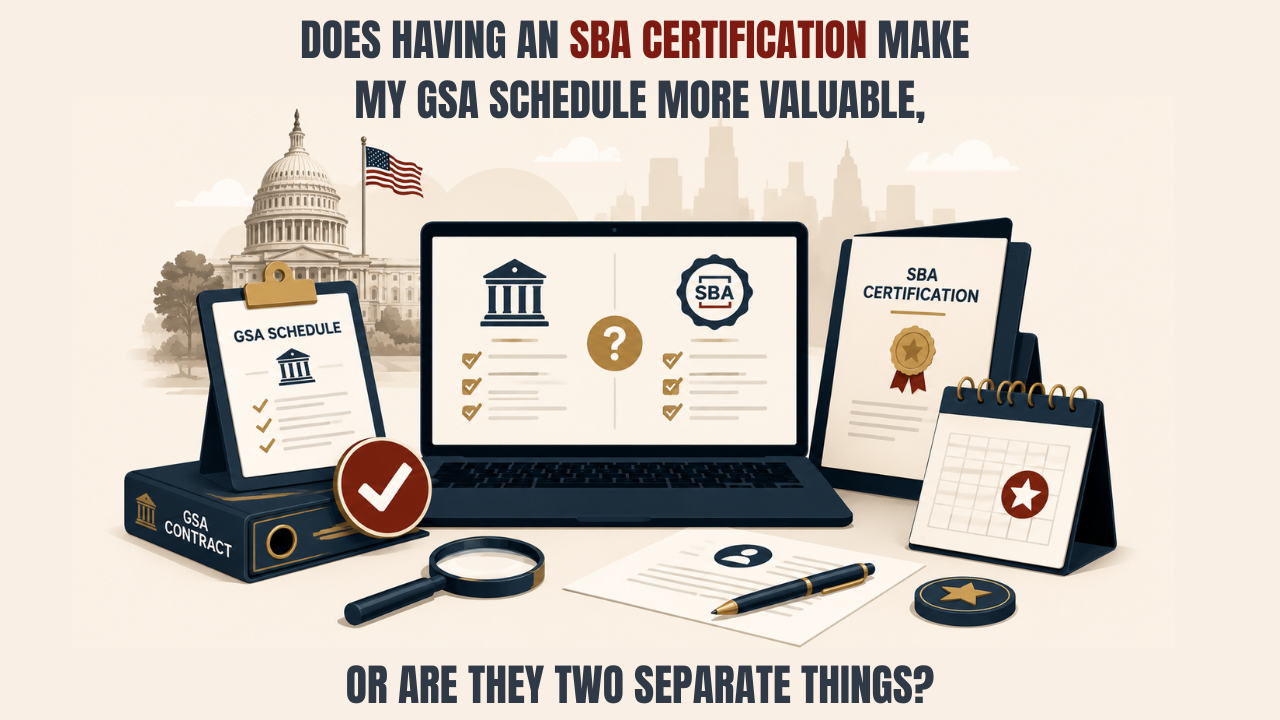
You are 8(a) certified, or SDVOSB, or WOSB. You also just landed your GSA Schedule. Somewhere in the back of your head is a quiet question nobody answered cleanly during either process: do these two things actually work together, or did you just spend a year stacking up paperwork that lives in separate drawers?
Here is the direct answer. An SBA certification and a GSA Schedule are two separate things that do two different jobs, and they compound when you run them together. A GSA Schedule is a contract vehicle: it makes you fast and easy for an agency to buy from. An SBA certification (8(a), SDVOSB, HUBZone, WOSB) is a status: it makes an agency want to buy from you, because purchasing from you helps that agency hit its small business goals. Neither requires the other. Held together and used deliberately, they make you one of the easiest, most rewarding vendors a contracting officer can choose. The catch is that most certified firms hold both and use them as if they were unrelated.
This is a strategy question, not a paperwork question, which is why it routes to how you position in the market rather than how you file. Let’s break down what each piece actually does, where they connect, and the sequencing decisions that trip people up.
Do I Need an SBA Certification to Get a GSA Schedule?
No. You can get and hold a GSA Schedule with no SBA certification at all. The Multiple Award Schedule (MAS) program is open to businesses of any size that meet the qualification requirements, and plenty of large firms hold Schedules.
So the two are genuinely independent. A certification is not a prerequisite for a Schedule, and a Schedule is not a prerequisite for a certification. You can hold either, both, or neither. What changes is not your eligibility to exist on the Schedule. It is your competitive position once you are on it. An uncertified small business and a certified one can sell the identical service on the identical Schedule and have completely different odds of winning a given order, because of how agencies are allowed to direct that order.
What Does an SBA Certification Actually Do on a GSA Schedule?
A certification lets agencies steer Schedule orders specifically to you and count the purchase toward their small business goals. It converts you from “a vendor they could buy from” into “a vendor it is advantageous for them to buy from.”
The mechanism is the order-level set-aside. Under FAR 8.405-5, an ordering activity may, at its discretion, set aside orders and Blanket Purchase Agreements (BPAs) under a Schedule for any of the socioeconomic small business categories: 8(a), HUBZone, SDVOSB, and WOSB. When a contracting officer sets an order aside for SDVOSB, only SDVOSB Schedule holders can compete for it. If you hold the matching status, your competition on that order shrinks to the small set of certified vendors under your SIN. If you do not, you never see it.
There is a real 2026-relevant development here. GSA Class Deviation RFO-2025-19 directs that when a contracting officer sets aside a Schedule order above the simplified acquisition threshold, they shall first consider setting it aside for the socioeconomic programs (8(a), HUBZone, SDVOSB, WOSB) before defaulting to a general small business set-aside. In plain terms: the trend in federal buying is pushing more orders toward specifically certified firms, not fewer. If you hold one of these certifications and a Schedule, the policy wind is at your back.
| Certification | Who it is for | What it adds on a Schedule |
|---|---|---|
| 8(a) | Socially and economically disadvantaged owners (9-year program) | Set-aside orders plus the possibility of sole-source orders directed to you without competition |
| SDVOSB | Service-disabled veteran owners | Access to SDVOSB set-aside orders; strong pull at VA and DoD |
| WOSB / EDWOSB | Women-owned (and economically disadvantaged women-owned) firms | Access to WOSB set-aside orders in eligible industries |
| HUBZone | Firms in historically underutilized business zones | Access to HUBZone set-aside orders; counts toward a goal agencies routinely miss |
Note the 8(a) row. It is the only one of the four that opens a sole-source path, where an agency can direct an order to you without running a competition at all (within program dollar thresholds). That single difference is why 8(a), when paired with an active Schedule, is one of the most powerful positions a small federal contractor can hold.
What Is the Difference Between FAR Part 8 and FAR Part 19 Set-Asides?
The difference is discretion. On the open market, FAR Part 19 set-asides are often mandatory; on a Schedule, FAR Part 8 set-asides are discretionary. Same goal, different rulebook, and it changes how you compete.
Under FAR Part 19, open-market buys are governed by the “rule of two”: if a contracting officer reasonably expects at least two capable small businesses to bid at a fair price, the buy must be set aside for small business. It is a requirement. Under FAR Subpart 8.4, which governs Schedule buys, set-asides are at the ordering activity’s discretion. The contracting officer may set an order aside, but is not generally compelled to by the rule of two.
| Factor | FAR Part 19 (open market) | FAR Part 8 (GSA Schedule) |
|---|---|---|
| Set-aside trigger | Rule of two, often mandatory | Discretionary (FAR 8.405-5) |
| Speed of buy | Slower, full open-market procedures | Faster, pre-negotiated pricing and terms |
| Goal credit | Counts toward agency small business goals | Also counts, when the awardee meets the order’s NAICS size standard |
| Your leverage | The rule works for you automatically | You have to make the set-aside attractive to the CO |
This is the part certified firms miss. On a Schedule, the certification does not automatically force a set-aside the way the rule of two can on the open market. The contracting officer still chooses. Your job is to make choosing you the obvious move: be visible on eBuy, have a complete catalog, and make it easy for a CO who needs to hit a HUBZone or SDVOSB number to see that you are the clean way to do it. The certification is the qualification. Giving the buyer a reason and a path to use it is the strategy.
If you are certified and still not seeing set-aside orders, the gap is almost never your eligibility. It is positioning, and that is exactly the kind of thing worth pressure-testing against how agencies in your space are actually buying before you write off the certification as not working.
Is OASIS+ Easier to Win With a Small Business Certification?
Yes, structurally. OASIS+, GSA’s best-in-class services vehicle, is built with separate small business pools, so a certification does not just help at the margins. It can be your entire entry path.
OASIS+ is organized into six pools: one Unrestricted pool plus five small business pools covering Total Small Business, 8(a), WOSB, HUBZone, and SDVOSB. Each pool is its own competition with its own awards, all sharing the same 13 professional services domains. A certified firm can pursue (and hold awards in) multiple pools at once. If you are both 8(a) and SDVOSB, you can compete in both pools, multiplying the task-order lanes open to you. Phase II opened all solicitations on a continuously open, rolling-award basis in 2026, so the on-ramp is not a one-time window you missed.
The strategic read: on OASIS+, your certification is not a tiebreaker. It is a door. The 8(a), HUBZone, SDVOSB, and WOSB pools exist specifically so certified firms compete against a smaller, like-credentialed field instead of the full open market. That is the clearest example of certification and vehicle compounding rather than overlapping.
Should I Get Certified Before or After Applying for a GSA Schedule?
It depends on which one unlocks revenue faster for your specific business, and in most cases the certification should come first or in parallel. The reason is simple: the Schedule is the channel, and the certification is what makes the channel pay off once you are in it.
Here is the decision logic. If you already qualify for a certification and have not pursued it, get it moving now, because it determines which set-aside orders and OASIS+ pools you can even access once your Schedule is live. Walking onto a Schedule uncertified when you were eligible all along means competing in the open lane while certified peers fish a smaller pond. If your business does not clearly qualify for any certification, do not let that stall the Schedule; the Schedule stands on its own and you pursue full-and-open and small business work without it. The mistake to avoid is sequencing them as two unrelated projects years apart, when planning them together compresses your time to first revenue.
One caution worth naming: some certifications take real time. The 8(a) program in particular involves a substantive application and a nine-year clock that starts at admission. Burning early 8(a) years without an active Schedule or a plan to use the status is a waste of the most valuable window you get.
Our Take
The most expensive mistake we see is not failing to get certified. It is treating the certification as the finish line. A firm spends months earning 8(a) or HUBZone status, frames the certificate, and then waits, as if the status itself generates orders. It does not. A certification you do not actively use on task orders is a credential, not a pipeline.
Capitol 50’s view is that a Schedule and a certification are two halves of one position, and the value lives entirely in how you operate them together: the right SINs, an eBuy habit, a catalog that makes set-asides easy for a CO to award, and outreach to the agencies whose goals your status helps them hit. That integration is the whole point of GSA Verticalization™, connecting status, vehicle, compliance, and targeting into one path instead of four separate accomplishments that never talk to each other. The certified firms that win are not the ones with the most certifications. They are the ones who turned a certification into a reason for a specific buyer to pick them this quarter.
Frequently Asked Questions
Do I need an SBA certification to get a GSA Schedule? No. The GSA Multiple Award Schedule program is open to businesses of any size that meet the qualification requirements, and a certification is not a prerequisite. A certification does not make you eligible for a Schedule; it changes your competitive position once you hold one by opening set-aside orders to you.
Does an 8(a) certification help me win more GSA task orders? Yes. 8(a) status lets agencies set aside Schedule orders for 8(a) firms and, uniquely among the certifications, can support sole-source orders directed to you without competition within program dollar thresholds. Paired with an active Schedule and a complete catalog, 8(a) is one of the strongest positions a small federal contractor can hold.
Can I use my SDVOSB status on GSA eBuy? Yes. When a contracting officer sets aside a Schedule order for SDVOSB under FAR 8.405-5, only SDVOSB Schedule holders can see and quote it, and eBuy can surface set-aside RFQs matched to your SINs and status. Your status narrows the competing field to other certified SDVOSB vendors under your SIN.
Is OASIS+ easier to win with a small business certification? Structurally, yes. OASIS+ has separate pools for Total Small Business, 8(a), WOSB, HUBZone, and SDVOSB, each with its own awards across the same 13 domains. A firm with multiple certifications can compete in multiple pools at once, expanding the task-order lanes available to it.
Should I get certified as WOSB or HUBZone before applying for a GSA Schedule? If you clearly qualify, pursue the certification first or in parallel, because it determines which set-aside orders and OASIS+ pools you can access once the Schedule is live. If you do not clearly qualify, do not delay the Schedule; it stands on its own. The costly path is treating them as two unrelated projects years apart.
Turn Two Credentials Into One Winning Position
If you are holding both a certification and a Schedule and still feel like nothing is compounding, you are not missing a third credential. You are missing the operating plan that connects the two. Bigger competitors do not have a secret certification. They have someone whose job is making sure every set-aside a CO can award is one you are visible and ready for.
A Federal Market Strategy call is a working read on your specific position: whether your SINs and certification actually match the set-aside demand in your space, where your catalog or eBuy presence is costing you orders you qualify for, and which agencies’ goals your status is built to satisfy. It is a plan for your combined position, not a pitch.
→ Start Your Federal Growth Plan
You already did the hard part twice. The last step is making the two assets work as one.