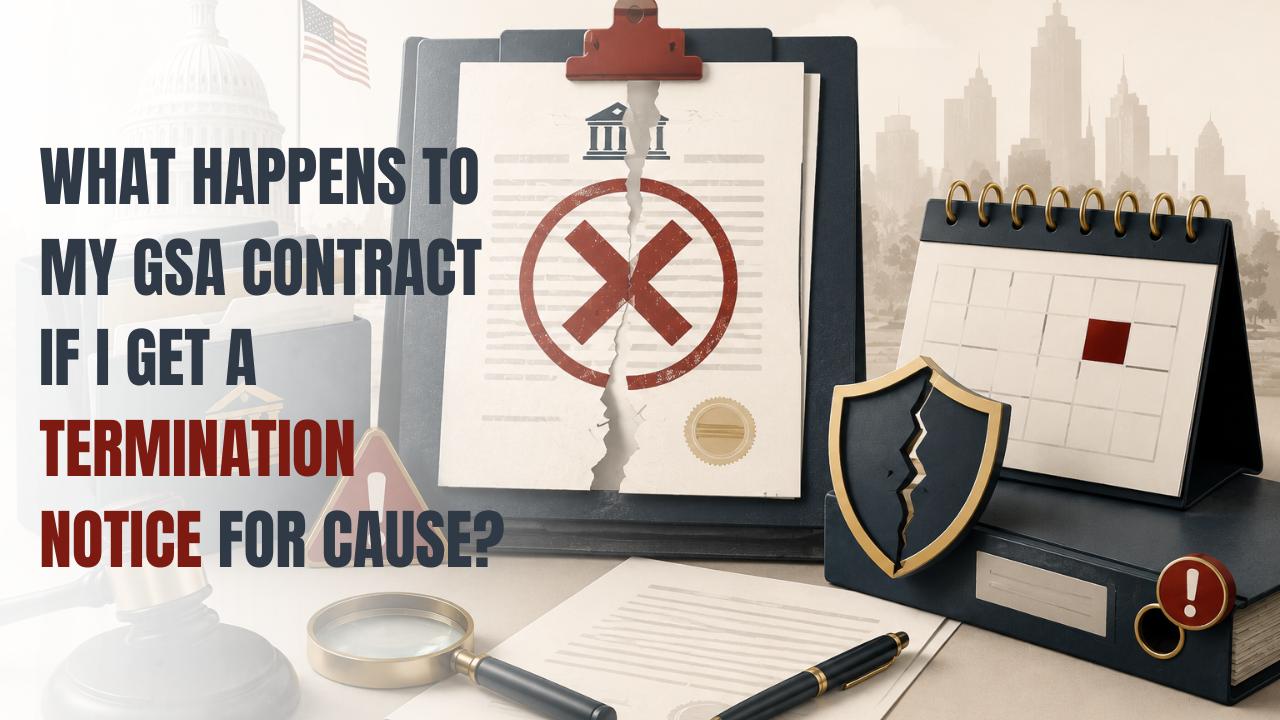
The letter arrives on a Tuesday. Your contracting officer is moving to terminate your GSA Schedule for cause, and you have a deadline measured in days, not weeks. Before you panic or fire off a defensive email, understand this: a termination for cause on a GSA Schedule is the government ending your Multiple Award Schedule (MAS) contract because it has determined you failed to perform or failed to comply with the contract’s terms. It is governed by FAR 52.212-4(m), the commercial-item clause, not the older default rules contractors often read about online. That distinction changes everything about how you respond, and whether your contract survives.
Most of what you will find searching this topic describes termination for default under FAR Part 49. That is the wrong rulebook for a Schedule. GSA Schedules are commercial-item contracts under FAR Part 12, and the requirements of Part 49 do not apply to them. If you are reading guidance built around the standard default clause, you are preparing for the wrong fight.
What Is a Termination for Cause on a GSA Schedule?
A termination for cause is the government’s decision to end your contract because of something you did or failed to do. Under FAR 52.212-4(m), the contracting officer may terminate for cause in the event of any default, any failure to comply with contract terms and conditions, or your failure to provide adequate assurances of future performance when asked.
That last trigger surprises people. You do not have to miss a delivery to be at risk. Falling out of compliance with a material term, failing your sales minimum, ignoring a Mass Modification, or letting your SAM.gov registration lapse can all open the door. The contracting officer’s discretion is wide, but it is not unlimited. They still have to justify the decision, and you still have the right to contest it.
The financial exposure is real. In a termination for cause, the government will not pay you for supplies or services it has not accepted, and you can be held liable for any excess costs the government incurs getting the work done elsewhere. That is why the response window matters so much.
What Is the Difference Between Termination for Cause and Termination for Convenience?
The difference is fault, and it controls both your liability and your record. A termination for convenience means the government no longer needs the contract and is ending it through no fault of yours. A termination for cause means the government is blaming you.
| Factor | Termination for Cause | Termination for Convenience |
|---|---|---|
| Reason | Your alleged failure to perform or comply | Government no longer needs the contract |
| Who is at fault | The contractor | No one |
| Payment | No payment for unaccepted work; possible excess-cost liability | Costs incurred plus reasonable settlement |
| Past performance record | Damaging; follows you into future bids | Generally neutral |
| Governing clause | FAR 52.212-4(m) | FAR 52.212-4(l) |
There is a built-in escape hatch worth knowing. FAR 52.212-4(m) states that if a termination for cause is later determined to be improper, it is converted into a termination for convenience. That conversion is exactly what a strong response, or a successful appeal, is fighting to win.
What Does a Cure Notice or Show Cause Notice Mean?
A cure notice is a formal warning that you have a performance or compliance problem and a set period to fix it before the government moves to terminate. A show cause notice is a demand that you explain why your contract should not be terminated, usually issued when the problem is already serious.
For a Schedule under FAR 52.212-4, the contracting officer is directed to send a cure notice before terminating for cause for any reason other than late delivery. The standard cure period referenced in the FAR cure-notice procedure is 10 days, though the contracting officer can specify a longer window depending on the circumstances. Read your notice carefully: the exact number of days and the exact deficiency cited are both in the letter, and both govern your next move.
Do not confuse the two notices. A cure notice is an opportunity. It tells you the problem and gives you a chance to fix it. A show cause notice is closer to the edge: it signals the government is leaning toward termination and wants your justification on the record. Either way, the clock is running from the date on the letter, not the date you opened it.
If you are holding one of these notices right now and you are not sure whether your contract can still be saved, that uncertainty is exactly what the Contract Recovery assessment is built to resolve. Find out where your contract actually stands before the response window closes.
How Do I Respond to a GSA Termination or Cure Notice?
Respond in writing, on time, and with evidence. A timely, documented response is your single best tool for stopping a termination for cause or setting up a later appeal.
Here is the sequence that protects you:
- Read the notice and calendar the deadline. Identify the exact cited deficiency, the governing clause, and the response date. Treat that date as immovable.
- Pull your contract file. Find the specific term or performance standard the government says you breached. You cannot rebut a claim you have not located in your own contract.
- Gather your evidence. Delivery records, correspondence with the CO, sales reports, compliance documentation, anything showing you performed or showing the failure was outside your control.
- Draft a cure plan, not an excuse. If the deficiency is real, the CO wants to see a concrete, dated plan to fix it. Vague reassurance reads as no plan at all.
- Respond in writing before the deadline. Address the specific allegation, present your evidence, and provide the assurances of future performance the clause contemplates.
- Document everything. Send through a channel that creates a record. If this becomes an appeal, your paper trail is the case.
Waiting is the one move that has no upside. The deadline does not extend because you are gathering yourself, and silence is read as an admission that you cannot cure.
Can I Appeal a GSA Contract Termination for Cause?
Yes. A termination for cause is a final decision by the contracting officer, which means you can contest it under the Contract Disputes Act, either at the Civilian Board of Contract Appeals or the Court of Federal Claims. In those forums, terminations for cause are analyzed much like default terminations: the government carries the burden of justifying its decision, and you can raise defenses such as improper cause, government-caused delay, or waiver.
The practical reality is that appeals are slower and more expensive than a strong response to the cure notice. The cheapest place to win is before the termination is ever issued. The second cheapest is in the period right after, when conversion to a termination for convenience is still on the table. By the time you are litigating, you are spending real money to undo damage that an earlier response might have prevented.
Our Take
Capitol 50’s view is that almost every termination for cause we see traces back to a problem the contractor could see coming and chose to wait out. A missed Mass Mod, a sales figure drifting under the SIN minimum, a compliance gap flagged months earlier. The cure notice is not the beginning of the problem. It is the last formal warning before the consequence.
The contractors who keep their Schedules are not the ones with the best excuses. They are the ones who treat the notice as a deadline, respond with evidence, and bring in help before the window closes rather than after. The difference between a contract that gets saved and one that does not is usually measured in how fast the contractor moved, not how serious the underlying issue was.
Frequently Asked Questions
What is a termination for cause on a GSA Schedule? It is the government ending your Multiple Award Schedule contract because it determined you failed to perform or comply with the contract’s terms. For Schedules, it is governed by the commercial-item clause FAR 52.212-4(m), not the FAR Part 49 default rules.
How do I respond to a GSA show cause or cure notice? Respond in writing before the stated deadline. Identify the exact deficiency cited, gather evidence that you performed or that the failure was outside your control, present a concrete cure plan if the problem is real, and document everything through a channel that creates a record.
Can I appeal a GSA contract termination for cause? Yes. A termination for cause is a final contracting officer decision, so you can contest it under the Contract Disputes Act at the Civilian Board of Contract Appeals or the Court of Federal Claims. The government must justify the termination, and you can raise defenses.
What is the difference between termination for cause and for convenience? Cause means the government blames you for a failure to perform or comply, and it can carry excess-cost liability and a damaged past-performance record. Convenience means the government simply no longer needs the contract, through no fault of yours.
How long do I have to respond to a GSA cure notice? The standard cure period in the FAR cure-notice procedure is 10 days, but the contracting officer can set a longer window depending on the situation. The exact deadline is stated in your notice, and it runs from the date of the letter.
You Still Have a Window. Use It.
A cure notice is not the end of your Schedule. It is the short, specific period where the outcome is still yours to change. The contractors who lose their contracts are rarely the ones with the worst problems. They are the ones who let the deadline pass while deciding whether the situation was serious enough to act on.
The fastest way to know whether your contract can be saved is to get a clear read on where it actually stands against the specific deficiency cited. The Contract Recovery assessment does exactly that, in a few minutes, without a sales pitch attached.
→ Start Your Contract Recovery Assessment
Every day you wait narrows the options that are still open today.