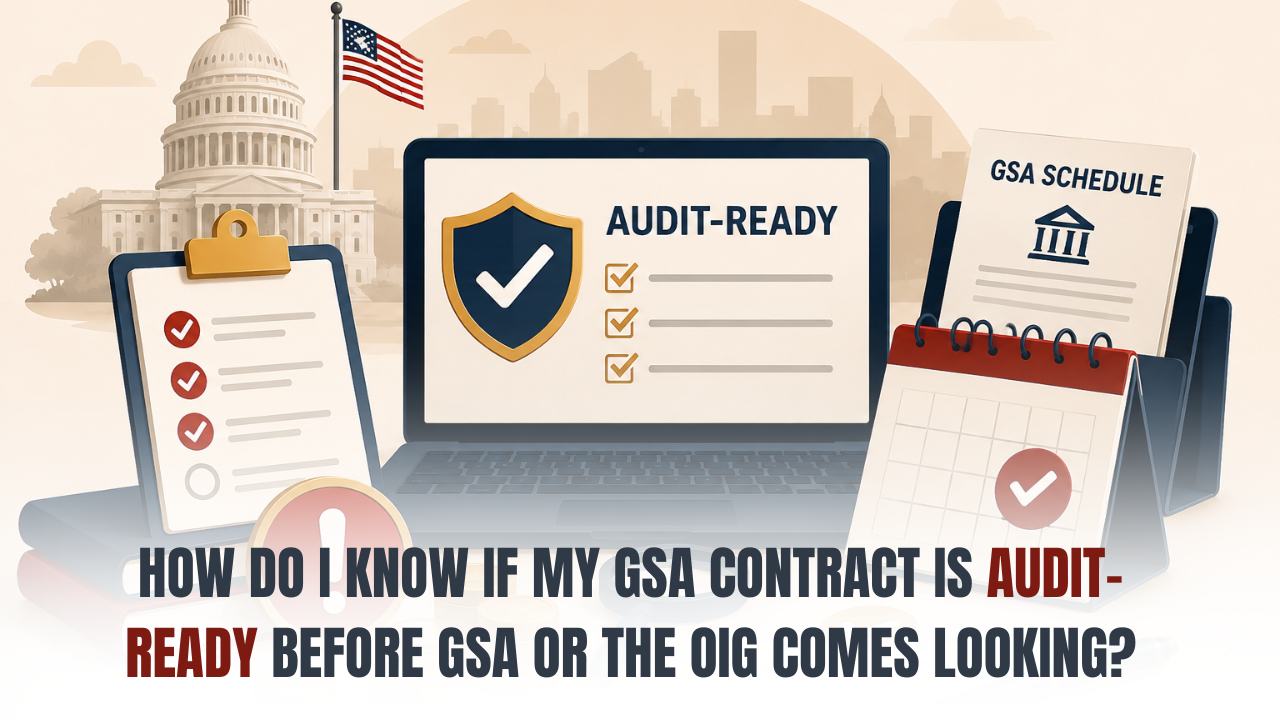
A GSA contract is audit-ready when the contractor can quickly prove that pricing, sales reporting, billing, catalog data, modifications, and contract administration decisions are accurate, supported, and consistent with the awarded MAS contract. Audit readiness is not just having the right answer. It is having the records to prove the answer without a last-minute scramble.
For growing MAS contractors, audit exposure often increases with contract activity. More orders, more invoices, more modifications, more pricing changes, and more catalog updates create more places for documentation gaps to appear.
What Does “Audit-Ready” Mean For A GSA Contractor?
Audit-ready means your MAS contract file is organized, current, and supported well enough that your team can respond to a GSA, contracting officer, or OIG review without rebuilding years of history. The issue is not whether your company meant to comply. The issue is whether your records prove that you complied.
In practical terms, audit readiness means you can explain and document:
- Why your awarded prices are supportable
- How your commercial pricing or TDR reporting is handled
- Whether sales were reported accurately
- Whether IFF was calculated and paid properly
- Whether invoices match contract terms
- Whether modifications were submitted when needed
- Whether your catalog and price list match your awarded contract
- Whether internal responsibilities are clear
- Whether decisions are documented, not just remembered
GSA OIG materials describe MAS contract audits as including preaward audits that help GSA contracting officials negotiate fair and reasonable pricing and postaward audits that examine contractor adherence to contract terms and conditions.
What Kinds Of Audits Affect GSA Contractors?
GSA contractors may face preaward audits, postaward audits, pricing reviews, billing reviews, Industrial Funding Fee reviews, and reviews related to contract terms and conditions. The GSA OIG has long described its MAS oversight role as including preaward, postaward, and performance audits.
Common audit or review types include:
| Review Type | What It Looks At | Why Contractors Get Exposed |
|---|---|---|
| Preaward audit | Pricing, commercial sales practices, disclosures, proposed rates, and negotiation support. | Unsupported pricing or incomplete commercial sales data can weaken negotiations. |
| Postaward audit | Whether the contractor followed contract terms after award. | Poor records can make compliant behavior hard to prove. |
| Defective pricing review | Whether pricing disclosures were current, accurate, and complete. | Outdated or unsupported pricing assumptions can create risk. |
| Billing review | Invoices, awarded rates, order terms, discounts, and billing logic. | Invoices may drift from awarded contract terms over time. |
| Industrial Funding Fee review | Sales reporting and IFF calculation. | Missed, miscoded, or underreported sales can create repayment and compliance issues. |
The most dangerous assumption is, “We would figure it out if they asked.” That is not audit readiness. That is a scramble plan.
How Do I Prepare My MAS Contract For An Audit?
Prepare your MAS contract for an audit by organizing your contract file, validating pricing support, reconciling sales reporting, reviewing invoices, confirming catalog accuracy, and documenting internal controls. The goal is to prove the contract has been managed consistently, not just react to a notice.
Use this five-part audit-readiness framework.
1. Pricing
Review whether your awarded prices are supported and explainable.
Check:
- Original pricing support
- Commercial price lists or market-rate documentation
- Discounting practices
- Basis of Award, if applicable
- Price Reductions Clause tracking, if applicable
- TDR reporting logic, if applicable
- Economic Price Adjustment history
- Modifications affecting rates or products
The GSA OIG has repeatedly focused on MAS pricing. In one report, the OIG stated that FAS pricing methodologies for MAS contracts had deficiencies and that some commercial pricing information accepted from offerors was unsupported, outdated, or lacked comparable commercial sales.
2. Reporting
Review whether GSA sales were reported accurately and IFF was paid correctly.
Check:
- Quarterly or monthly sales reports
- IFF payment records
- TDR reporting files, if applicable
- Internal sales classification rules
- Exclusions and inclusions
- Order-level reporting logic
- Reconciliation between invoices and reported sales
3. Catalog And Price List
Confirm your public-facing contract data matches your awarded contract.
Check:
- GSA Advantage catalog
- Text file or price list
- Labor category descriptions
- Product descriptions
- SIN assignments
- Awarded rates
- Deletions and additions
- FCP or SIP transition status, if applicable
GSA notes that MAS contractors may need to submit electronic contract data for GSA Advantage after option exercise or after applicable modifications.
4. Contract File
Your contract file should tell the story of the contract from award through today.
Keep organized copies of:
- Award documents
- Solicitation refresh acceptances
- Mass modifications
- Bilateral and unilateral modifications
- Pricing support
- CSP documentation, if applicable
- TDR records, if applicable
- Sales reporting records
- IFF payment support
- Correspondence with GSA
- Subcontracting plan records, if applicable
- Internal decision notes
5. Internal Controls
Audit readiness depends on people and process.
Confirm:
- Who owns GSA reporting
- Who reviews pricing changes
- Who approves discounts
- Who monitors mass mods
- Who updates catalog data
- Who reviews invoices against contract terms
- Who keeps the contract file current
If one person knows everything and nothing is documented, the company is not audit-ready. It is person-dependent.
What Records Should I Keep For GSA Compliance?
You should keep records that prove your pricing, sales reporting, billing, modifications, catalog updates, and contract decisions were accurate and consistent with your MAS contract. The records should be organized so someone outside the day-to-day process can follow the logic.
At minimum, maintain:
- Award package and final awarded terms
- Current and historical price lists
- Modification packages and approvals
- Commercial sales practice support, if applicable
- TDR submissions, if applicable
- Sales reports and IFF payment confirmations
- Invoices under GSA orders
- Discount approval records
- Basis of Award documentation, if applicable
- Price Reductions Clause monitoring, if applicable
- GSA correspondence
- Subcontracting plan reports, if applicable
- Internal SOPs for GSA sales classification
- Catalog upload records
- Labor category qualification support for service contracts
The test is simple: if GSA asks why a price, report, invoice, or modification was handled a certain way, can your team answer with documentation instead of memory?
What Is A Defective Pricing Review?
A defective pricing review looks at whether pricing disclosures or pricing-related data were accurate, current, and complete when GSA relied on them for negotiation or contract action. For MAS contractors, defective pricing risk often appears when commercial sales data, discounting practices, or pricing support do not match what was disclosed.
This risk is especially important for contractors that:
- Submitted Commercial Sales Practices
- Have complex discounting practices
- Sell to both commercial and federal customers
- Have multiple reseller or dealer channels
- Changed pricing policies after award
- Have not updated disclosures when required
- Cannot support historical pricing statements
The GSA OIG has identified MAS pricing concerns in multiple reports, including issues where CSP submissions were not current, accurate, or complete and where proposed labor rates were overstated or unsupported.
Defective pricing risk is not always caused by bad intent. Often, it comes from poor documentation, outdated disclosures, or sales teams making pricing decisions that contracts and compliance teams never reviewed.
How Can I Tell If My GSA Contract Is High-Risk?
Your GSA contract may be high-risk if pricing support is incomplete, sales reporting does not reconcile to invoices, modifications are messy, catalog data is outdated, or no one clearly owns contract compliance. Growth can also increase risk because more contract activity creates more documentation points.
High-risk warning signs include:
- You cannot locate the original pricing support.
- You do not know whether your contract is CSP or TDR.
- Sales reports are prepared manually without reconciliation.
- GSA invoices are not reviewed against awarded rates.
- Discounts are approved informally.
- Labor categories are billed without qualification support.
- Commercial pricing changed but GSA disclosures were not reviewed.
- Products or services on GSA Advantage are outdated.
- Mass modifications are unsigned or poorly tracked.
- Internal ownership changed and no transition file exists.
- Your contract has grown quickly but controls have not matured.
If several of these apply, the contract may not be audit-ready even if it has not received any formal notice.
If your team is unsure where the weak spots are, CAP50’s GSA Schedule management support can help review the contract file, reporting logic, pricing support, and post-award administration before a review turns into a scramble.
What Is The Difference Between Compliance And Audit Readiness?
Compliance means the contractor is following the contract. Audit readiness means the contractor can prove it quickly, clearly, and consistently. A company can be generally compliant but still struggle during a review if records are scattered, logic is undocumented, or internal owners disagree.
| Area | Compliant In Theory | Audit-Ready In Practice |
|---|---|---|
| Pricing | Rates appear consistent with the contract. | Pricing support, approvals, modifications, and discount logic are documented. |
| Reporting | Sales are reported each period. | Reported sales reconcile to invoices, order data, and IFF payments. |
| Catalog | Items or services are listed. | Catalog data matches the awarded contract and modification history. |
| Contract file | Documents exist somewhere. | Documents are organized, current, and tied to decisions. |
| Internal ownership | Someone usually handles GSA matters. | Roles, review steps, and escalation paths are defined. |
The gap between “we did it right” and “we can prove we did it right” is where many contractors get uncomfortable.
Consultant’s View
The contracts that worry me most are not always the ones with obvious violations. They are the ones where nobody can explain why a rate changed, why a sale was excluded, why a modification was never submitted, or why the catalog does not match the awarded file.
Audit readiness is a discipline. It is built through organized files, consistent decision-making, and contract maintenance habits long before anyone asks for records.
Why Does Growth Increase GSA Audit Exposure?
Growth increases audit exposure because a growing MAS contract produces more transactions, invoices, discounts, modifications, sales reports, catalog updates, and internal handoffs. More activity is good for revenue, but it creates more compliance evidence to manage.
Growth-related risks include:
- More sales that must be classified correctly
- More IFF calculations
- More pricing exceptions
- More customer-specific discounts
- More labor category billing
- More products or services added to the contract
- More personnel touching contract activity
- More chances for internal process drift
A contractor with $25,000 in GSA sales may have a small audit trail. A contractor with millions in MAS activity needs mature controls. The compliance system has to grow with the contract.
How Often Should I Review My GSA Contract For Audit Readiness?
You should review GSA audit readiness at least annually, and more often if your contract has significant sales activity, frequent modifications, pricing changes, new labor categories, TDR reporting, or upcoming option renewal. Waiting until an audit notice arrives usually means the review becomes reactive and stressful.
A practical cadence:
- Monthly: Sales reporting, TDR data if applicable, invoice sampling, and internal issue log
- Quarterly: IFF reconciliation, sales classification review, and catalog spot check
- Semiannually: Pricing support, discounting practices, and modification status
- Annually: Full contract-file review, SOP review, internal ownership review, and audit-readiness assessment
- Before option renewal: Contract-health and audit-readiness cleanup
The goal is not to overburden the team. The goal is to prevent a contract that is quietly drifting out of control.
FAQ: Apply FAQPage Schema
What Kinds Of Audits Affect GSA Contractors?
GSA contractors may be affected by preaward audits, postaward audits, pricing reviews, billing reviews, Industrial Funding Fee reviews, and reviews of compliance with contract terms. GSA OIG materials describe preaward audits as support for pricing negotiations and postaward audits as reviews of contractor adherence to contract terms and conditions.
How Do I Prepare My MAS Contract For An Audit?
Prepare by organizing the contract file, validating pricing support, reconciling sales reporting to invoices, reviewing IFF payments, checking catalog accuracy, and documenting internal controls. The goal is to prove compliance quickly with records, not memory.
What Records Should I Keep For GSA Compliance?
Keep award documents, modifications, pricing support, sales reports, IFF payment confirmations, invoices, discount approvals, catalog records, GSA correspondence, subcontracting records if applicable, and internal SOPs. Records should be organized enough that a reviewer can follow the contract history.
What Is A Defective Pricing Review?
A defective pricing review examines whether pricing disclosures or pricing-related data were current, accurate, and complete when GSA relied on them. Defective pricing risk often appears when commercial sales practices, discounting, or pricing support do not match what was disclosed or negotiated.
How Can I Tell If My GSA Contract Is High-Risk?
Your contract may be high-risk if pricing support is missing, sales reporting does not reconcile, invoices do not match awarded rates, catalog data is outdated, modifications are incomplete, or no one owns GSA compliance internally. Multiple small gaps can create serious audit-readiness risk.
Clean Up The File Before Someone Asks For It
Audit readiness is not a legal theory. It is an operational habit. If your pricing support, reporting logic, invoice review, catalog data, and modification history are not organized now, they will not magically become organized when GSA or the OIG asks questions.
CAP50 helps contractors assess audit readiness, clean up contract files, review reporting and pricing logic, and build practical post-award compliance routines. The objective is simple: know where the risk is before someone else finds it for you.