The citation in the RFQ looks familiar. The buying process behind it may not be.
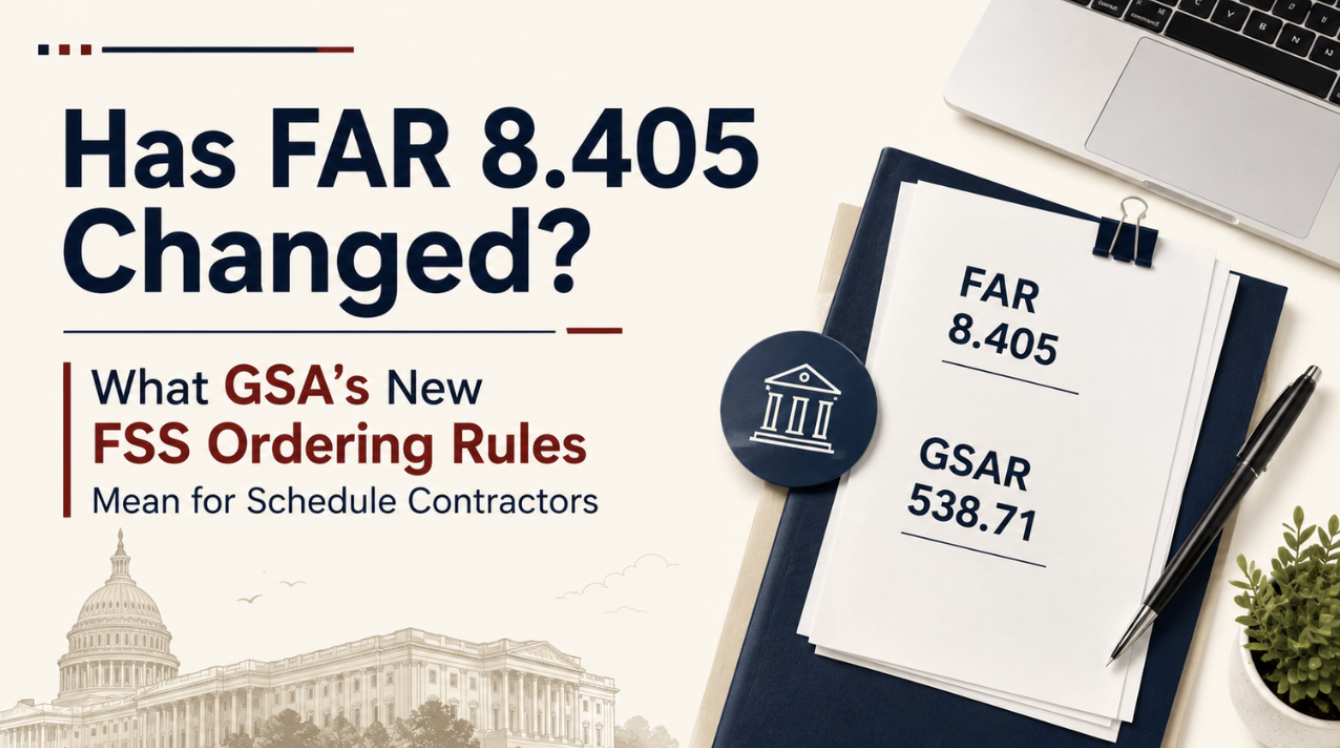
GSA’s Federal Supply Schedule ordering procedures have been established in GSAR Subpart 538.71 through a class deviation supporting the FAR Overhaul. For Schedule contractors, that means the familiar FAR 8.405 framework is no longer the only place to understand how agencies solicit, evaluate, document, and award Schedule orders and BPAs. The contract scope still controls what you can sell. The buyer’s ordering rules shape how you must compete.
This is not a reason to become a procurement lawyer before submitting every quote. It is a reason to stop treating an old FAR citation as a substitute for reading the actual RFQ, its applicable ordering procedures, and your contract terms.
What Changed in the FSS Ordering Procedures?
GSA moved the core procedures for placing orders and establishing BPAs against Federal Supply Schedule contracts into GSAR Subpart 538.71 under the RFO-2025-FSS-GSAR 538 class deviation. The stated objective was to streamline the prior, more prescriptive framework while keeping the statutory safeguards behind Schedule competition.
The procedures still recognize that FSS ordering is a competitive process. They also retain key concepts contractors care about, including competition above the micro-purchase threshold, award-decision documentation, small-business consideration, pricing discounts and concessions, and sole-source justification requirements. Read the current FSS ordering procedures on Acquisition.gov.
The important distinction is this: simplified language does not mean simplified preparation. A contractor still has to show that its quoted solution is within the awarded Schedule scope, responds to the requirement, and can stand up to the buyer’s best-value or price evaluation.
Does This Change How I Should Respond to an RFQ?
Yes. Contractors should respond to the actual evaluation path in the RFQ instead of using a generic Schedule quote template.
The revised framework places more emphasis on the complexity of the acquisition and whether the required solution is available at a fixed price. That is a signal to clean up the first page of every quote. A contracting officer should be able to see, without inference:
• Schedule authority: Contract number, awarded SIN, and the specific products, labor categories, or services being quoted.
• Scope fit: A direct explanation of how the awarded offering meets each material requirement.
• Price fit: A transparent connection between the quoted price, the awarded ceiling, and any order-level discount.
• Performance fit: The proposed delivery approach, teaming structure if any, and who is responsible for each task.
The buyer’s procedures may be streamlined. The buyer still has to document a fair award decision. Make that decision easy to defend.
What Still Applies Above the Micro-Purchase Threshold?
Above the micro-purchase threshold, an ordering activity generally has to seek at least three quotes or document why doing so is not practicable. The procedures also require enough documentation to support the award decision and show that quotations were fairly considered.
That is good news for a qualified small contractor. It means an agency is not required to default to the largest familiar brand simply because the work sits on a Schedule. But it also means a thin quote that assumes the buyer will fill in the gaps is unlikely to survive comparison.
| What The Buyer Needs | What Your Quote Should Make Clear | Common Contractor Error |
| A solution within Schedule scope | The exact awarded SIN and offering supporting each element. | Quoting a commercial capability that has not been added to the contract. |
| A fair basis for award | A readable scope, price, and delivery response that maps to the RFQ. | Submitting a generic capability statement instead of a quote. |
| Price reasonableness | Any discount, total evaluated price, and assumptions affecting price. | Offering a low price with no explanation of what is included. |
Can I Use a Contractor Teaming Arrangement Under the New Rules?
Yes. The FSS ordering procedures expressly allow two or more FSS contractors to combine their offerings and propose a Contractor Teaming Arrangement, or CTA, to meet an ordering activity’s need.
That is not the same as casually promising a subcontractor’s work in your quote. A MAS CTA is an agreement between Schedule contractors, and each team member must contribute offerings within its own contract scope. The arrangement should clearly identify the members, their Schedule contract numbers, task responsibilities, and proposed prices. GSA’s CTA guidance explains the permitted structures and required agreement elements.
For smaller firms, a well-built CTA can be the difference between passing on a larger requirement and offering a credible total solution. It only works when the agreement is built before the quote, not after award.
What Did Not Change?
Your Schedule does not become a license to quote anything a buyer requests. The work still must be within the scope of the awarded contract. Your ceiling prices still matter. Your reporting, Industrial Funding Fee, and contract terms still apply.
The changed ordering procedures create flexibility for buyers. They do not excuse contractors from knowing their SIN scope or keeping their contract current. If the opportunity requires a labor category, product, or service you do not have awarded, resolve that issue through a modification, a properly structured CTA, or a different acquisition path selected by the government.
If your quotes repeatedly fail because the scope is close but not quite right, the problem may be your GSA Schedule management, not your proposal writing.
Our Take
The best contractors will not win because they memorize GSAR 538.71. They will win because they translate the rule into a cleaner quote: awarded scope tied to every requirement, transparent pricing, and a delivery plan that makes the contracting officer’s decision easier.
That is the operating side of GSA Verticalization™. Compliance does not sit in a separate binder from growth. The precision that keeps a quote within scope is the same precision that makes a buyer trust you with an order.
Related Resources
• What Does the FAR Overhaul Moving to Formal Rulemaking Mean for Small Business Contractors?
• How Do I Actually Win Work on My GSA Schedule?
Frequently Asked Questions
Are the New FSS Ordering Procedures Mandatory?
GSA’s class deviation establishes the FSS ordering procedures for use by ordering activities. Contractors should read the solicitation and agency instructions for the specific order because the RFQ controls the response requirements.
Does FAR 8.405 No Longer Matter?
The historical FAR 8.4 framework remains important context, but GSA’s current FSS ordering procedures are established in GSAR Subpart 538.71 through the class deviation. Do not rely on a familiar citation without confirming the instructions that govern the opportunity.
Can a Small Business Use a CTA on a Set-Aside Order?
Potentially, but the CTA lead and members must meet the applicable socioeconomic-status requirements, and the arrangement must comply with limitations on subcontracting. Review the RFQ and the CTA requirements before proposing the team.
Can I Quote an Offering That Is Not on My Schedule Yet?
Not as an awarded MAS offering. Confirm scope before you bid. Depending on the requirement, a contract modification, a CTA, or a government-selected alternative acquisition approach may be necessary.
What Should I Do When an RFQ Does Not State the Evaluation Method Clearly?
Submit questions by the deadline. Do not assume that a generic lowest-price strategy is appropriate. Your quote should respond to all stated requirements and make the relationship between scope, price, and delivery clear.
Turn Schedule Rules Into a Better Quote
The procedures are only useful when they are applied to the work in front of you. A quote can look compliant and still fail because the SIN support is weak, the CTA is unclear, or the price does not match the buyer’s evaluation logic.
Capitol 50 can assess an active pursuit against your awarded scope, the applicable ordering rules, and the practical issues a template cannot resolve.
→ Start Your Schedule Pursuit Review
You do not need more regulatory language. You need a quote the buyer can confidently select.