In April 2026, GSA announced OneGov had saved taxpayers $1.1 billion in its first year. For agencies, that is a headline. For a GSA Schedule holder who makes a living reselling software, it landed differently: if agencies buy straight from Microsoft and Adobe, what happens to me?
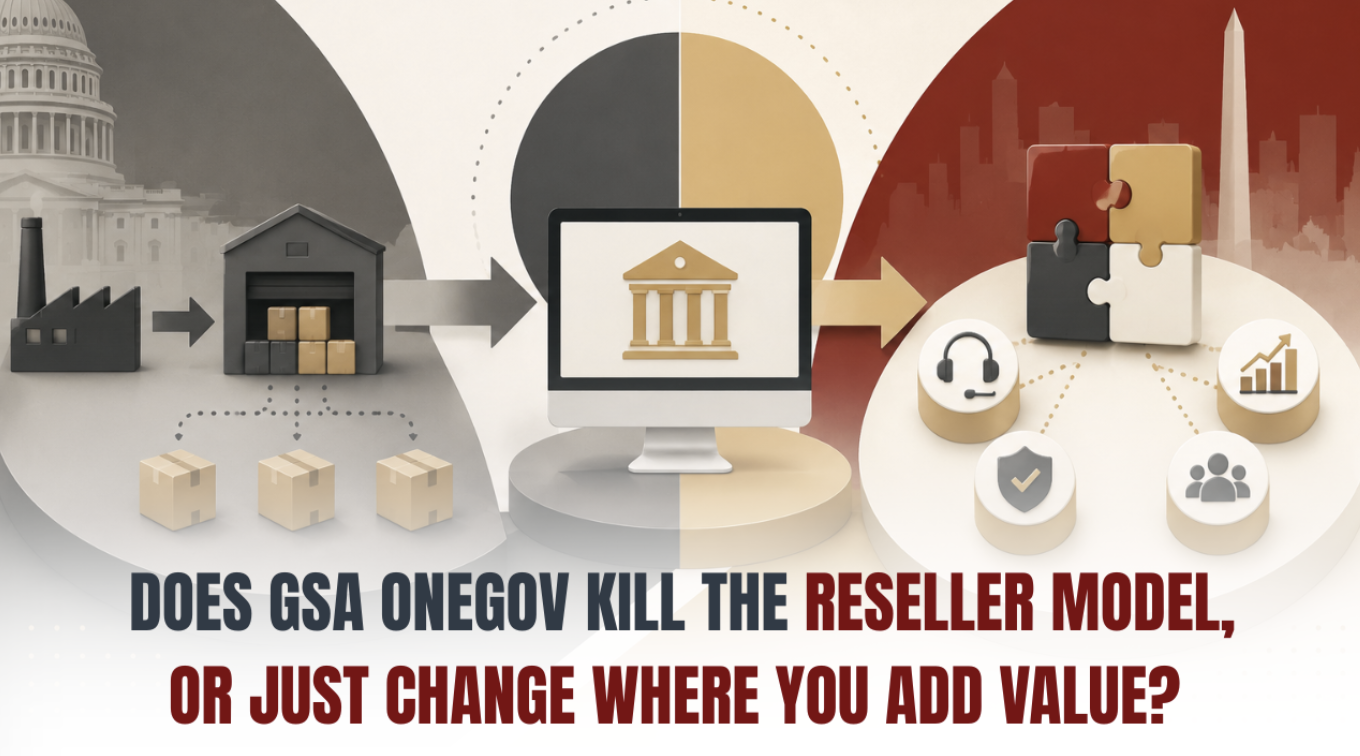
OneGov is GSA’s strategy of negotiating directly with original equipment manufacturers (OEMs) for governmentwide pricing, then making those deals available through the Multiple Award Schedule. It does not end the reseller model, but it moves the value. Resellers who only marked up licenses are exposed. Resellers who deliver implementation, integration, and compliance are not.
What Is OneGov, and How Big Has It Gotten?
OneGov is GSA’s initiative to consolidate fragmented federal software buying into a small number of centralized, governmentwide agreements negotiated directly with OEMs. The goal is to eliminate markup stacking and standardize terms across agencies.
As of its one-year mark in 2026, the program reported roughly $1.1 billion in first-year savings across about 20 unified agreements with major vendors. Those agreements span:
- Enterprise software and cloud: Microsoft, Adobe, Google, ServiceNow, Snowflake.
- Security: Palo Alto Networks and other cybersecurity providers.
- AI providers: Anthropic and Perplexity, among the named agreements bringing AI tools to federal users.
- Less conventional vendors: even mobility providers like Uber.
GSA negotiates these directly with the manufacturer to strip out reseller markup and secure discounts the agency has described as reaching as high as 90% off in some cases. The deals then live on the MAS, so the buying mechanism agencies already know stays intact.
If your reading of OneGov until now was “GSA gets cheaper software,” you have the agency’s side. The contractor’s side is the question this post answers.
Does OneGov Cut Resellers Out of Federal Software Sales?
Not entirely, and GSA has been explicit about it. In 2026 GSA leaders stated plainly: “We’re not anti-reseller. We’re anti-fragmentation.” The target is duplicative markup across a dozen middlemen, not the reseller function itself.
What actually changes is the structure of the deal:
- OEMs become the primes. Under a OneGov agreement, the manufacturer holds the governmentwide arrangement directly.
- Resellers and integrators move to channel-partner and subcontractor roles. You plug into the OEM’s agreement rather than holding the markup as the prime on a license-only sale.
- Resellers still share in negotiated discounts. Participation in the OneGov pricing does not disappear for partners; it routes through a different structure.
- GSA is actively shaping the reseller role. In January 2026, GSA issued a Request for Information seeking industry ideas to enhance reseller market oversight and value, a signal the agency is defining what a valuable reseller looks like, not eliminating the category.
The firms at real risk are the ones whose entire value proposition was “we hold the GSA Schedule and add 8% to the license.” That model was always thin. OneGov just made the floor visible.
If your federal revenue leans on software resale and you cannot name what you add beyond the markup, that is the gap to close now, and a federal growth review is where we map it.
Where Do Contractors Still Add Value Under OneGov?
Value moves from holding the license to delivering the outcome around it. OEMs negotiate price; they rarely deliver the services that make federal deployments work.
The defensible positions in a OneGov market:
- Implementation and integration. Standing up the software inside an agency’s environment, connecting it to existing systems, and making it usable.
- Customization and configuration. Tailoring enterprise tools to a specific agency mission, which OEMs do not do at scale.
- Training, change management, and adoption. Getting federal users to actually use what was bought, which is where most enterprise deals quietly fail.
- Compliance and security support. Helping agencies meet security standards and contract terms around the tool, including the documentation reviewers expect.
- Bundled solutions. Combining multiple products and services into a single mission outcome rather than selling one license line.
A reseller who repositions around these is not fighting OneGov. They are riding it, because every OneGov license an agency buys creates demand for someone to make it work.
How Should a GSA Schedule Reseller Respond in 2026?
Reposition your Schedule and your pitch around services and outcomes, not license markup, and get clear on which OEM channel programs you can join. The contractors who move first define their lane before the market sets it for them.
Three moves that matter this year:
- Audit your revenue mix. Separate pure license resale from services. The license-only share is your exposure; the services share is your foundation.
- Confirm your channel-partner status with the OEMs you sell. OneGov runs through the manufacturers; your relationship with them is now your access path.
- Reframe your capability statement and SINs around services. If your Schedule reads as a product catalog, it describes the part of your business OneGov is compressing. Lead with what you deliver.
Our Take
OneGov is the clearest signal in years of where federal software value is going, and it is not toward the middle of the supply chain. The reseller who panics reads “$1.1 billion saved” as a death notice. The reseller who is paying attention reads it as a map: GSA just told you the markup-only model is over and the services model is protected, and then issued an RFI asking the industry to define what a valuable reseller does. That is an invitation, not an eviction. We help contractors stop defending a position OneGov already took and reposition onto the ground the strategy actually rewards. This is the kind of repositioning GSA Verticalization™ exists to drive: aligning your contract, your SINs, and your go-to-market with where the federal buyer is actually going.
Frequently Asked Questions
What is GSA OneGov?
OneGov is GSA’s strategy of negotiating software and technology pricing directly with original equipment manufacturers for the whole federal government, then offering those agreements through the Multiple Award Schedule. It reported roughly $1.1 billion in first-year savings across about 20 vendor agreements.
Does OneGov mean agencies stop buying from resellers?
No. GSA has said it is “anti-fragmentation,” not anti-reseller. OEMs hold the prime agreements, while resellers and integrators participate as channel partners and continue to provide services like implementation, customization, and compliance support.
Which vendors have OneGov agreements?
Reported agreements include Microsoft, Adobe, Google, ServiceNow, Snowflake, Palo Alto Networks, and AI providers such as Anthropic and Perplexity, among roughly 20 total as of the program’s one-year mark in 2026.
How do resellers make money under OneGov?
By delivering value the OEM does not: implementation, integration, customization, training, change management, security and compliance support, and bundled solutions. Resellers can also still participate in OneGov-negotiated discounts through channel-partner arrangements.
Is OneGov bad for small business GSA contractors?
It is mixed. Pure license-markup resellers face pressure, but small firms that offer services around enterprise software can win higher-value work. GSA’s January 2026 RFI on reseller market value suggests the agency is defining a continued role for resellers, not removing them.
Find Your Lane Before the Market Sets It for You
OneGov did not end your federal software business. It told you, in public, which half of it is protected and which half is exposed. The contractors who repositioned around services this year look essential to agencies. The ones still selling markup are explaining their pricing.
A federal growth review is a working session on your specific Schedule: where your revenue is exposed to OneGov, which OEM channels you can join, and how to reframe your offer around the services agencies still have to buy from someone.
→ Start Your Federal Growth Review
You do not need OneGov to fail for your business to win. You need to be standing where it sends the work.