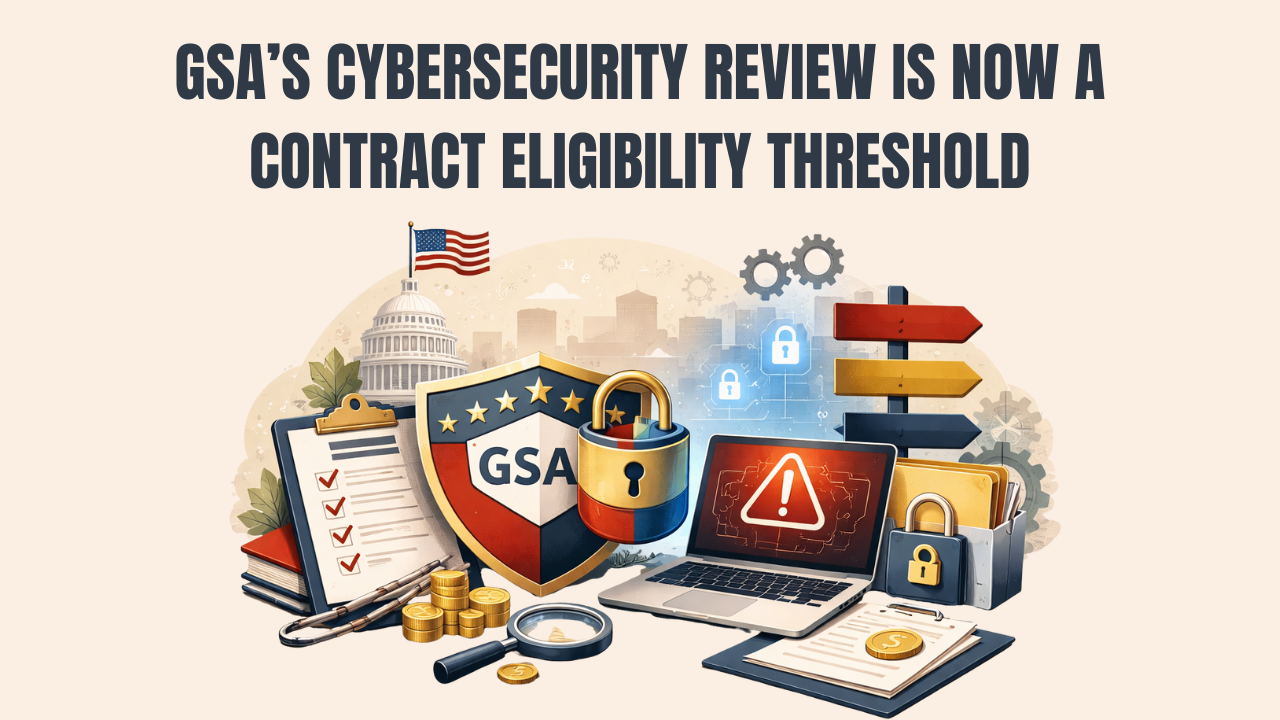
The shift occurred without passing through the acquisition signals contractors typically rely on to assess timing and exposure. There was no rulemaking sequence to monitor and no solicitation language flagging a change in eligibility. GSA contract actions involving controlled unclassified information are now subject to a cybersecurity approval threshold applied before award, and contractors encountering this requirement late are seeing delayed awards, constrained competition, or quiet removal from consideration.
This is not a developing policy posture. It is already influencing which contracts move forward.
GSA contract actions involving CUI now require documented, implemented cybersecurity controls aligned to NIST standards before award. Contractors unable to substantiate that posture face increased risk of delay or non-award.
Where the Exposure Actually Occurs
For years, cybersecurity obligations followed the award. Contractors planned remediation during performance and treated controls as an operational issue rather than a qualification condition. Bid strategy, staffing plans, and proposal timelines reflected that assumption.
That sequence no longer applies.
Cybersecurity is now evaluated as part of the acquisition decision itself. When control implementation or documentation cannot be reviewed and validated in real time, the contract action does not pause. It advances without the bidder. Strong pricing and technical strength do not offset missing evidence.
What This Changes for GSA Schedule Holders
The GSA Multiple Award Schedule has historically been administratively predictable. Compliance risk centered on pricing disclosures, labor category alignment, and modification accuracy. Cybersecurity rarely interrupted eligibility.
That stability no longer holds.
Contractors are encountering internal reviews that stall awards pending cybersecurity approval, task orders that never progress beyond screening, and teaming structures adjusted to remove CUI exposure altogether. These outcomes rarely surface as formal rejections. They occur upstream, before an award decision is documented.
Assumptions Driving Silent Contract Risk
During contract reviews, Capitol 50 continues to see eligibility risk created by interpretation gaps rather than technical failure.
CUI handling is treated as incidental rather than structural. Documentation exists across disconnected files rather than as a defensible compliance record. Control responsibility is deferred to vendors without contractor-level oversight. Legacy contract awards are assumed to insulate new actions from review.
Each of these positions collapses once a contract action triggers cybersecurity validation.
What Readiness Actually Requires Now
Cybersecurity readiness is no longer a technical posture. It is a contract qualification condition.
Contractors must be able to identify where CUI enters their environment, demonstrate that required controls are already implemented, and present documentation that withstands review without explanation or interpretation. Review sufficiency is determined by evidence at the time of award, not future remediation plans.
Post-Award Risk Does Not Disappear
For contractors already holding GSA awards, cybersecurity exposure continues beyond new bids. Gaps surface during option period exercises, scope increases tied to data access, contract modifications that introduce new information flows, and performance reviews connected to security posture.
When those moments occur, timelines compress. Corrective paths narrow. Reinstatement depends on documented resolution, not stated intent.
The Decision Point Comes Before Submission
At this stage, the risk is no longer theoretical. A bid is either positioned to clear internal review or it is not. Cybersecurity posture now influences that outcome before pricing, before evaluation, and before discussions ever occur.
For contractors moving forward on GSA opportunities involving controlled unclassified information, a direct GSA call with Capitol 50 becomes a control point. The conversation is structured around contract eligibility, documentation sufficiency, and whether the current posture withstands review under today’s thresholds.
That call determines whether the contract should proceed as planned, pause for correction, or be withheld entirely. Advancing without that determination shifts the risk onto the award itself.
A focused GSA review with Capitol 50 establishes that determination before submission.