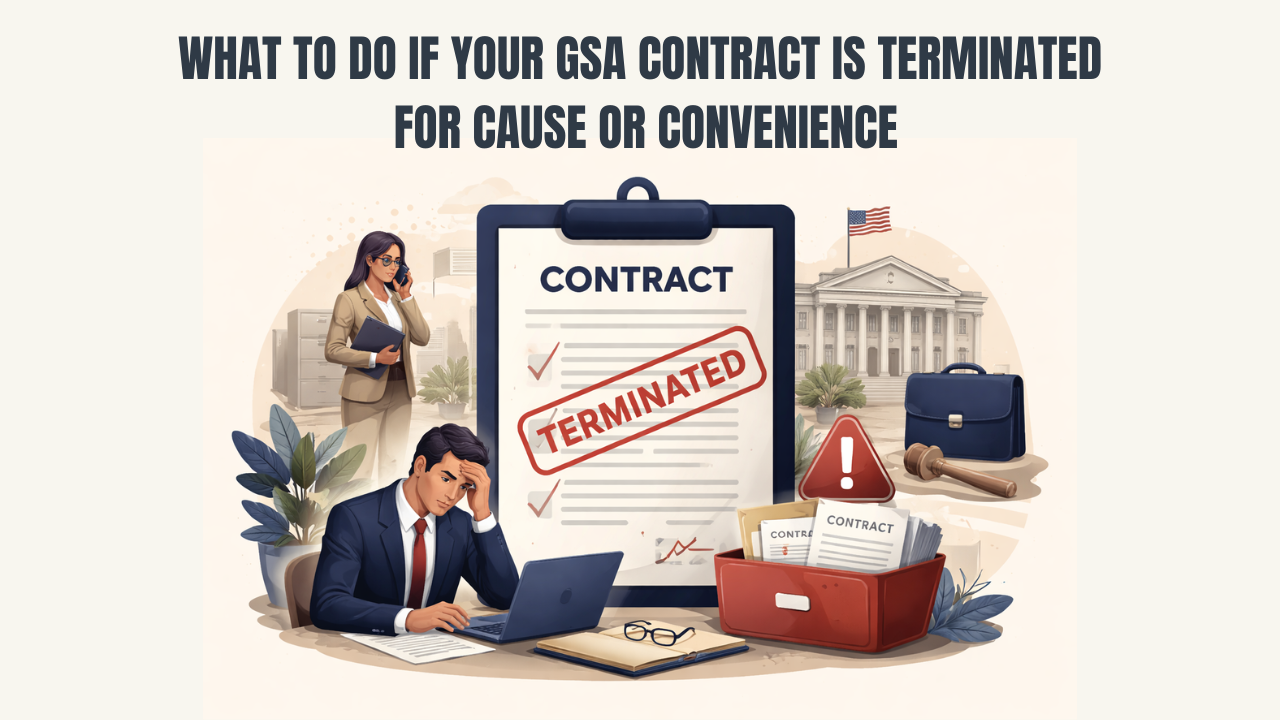
A termination under your GSA Schedule is not an administrative inconvenience. It is a recordable event. It alters how the government assesses your firm’s reliability, how future contracting officers interpret risk, and how much tolerance you will be given on your next submission.
What matters is where the termination occurred.
Most contractors miss this distinction. And that mistake follows them.
Short answer: if a task order under your GSA Schedule is terminated for cause or convenience, or if your GSA Schedule itself is terminated or cancelled, you must immediately assess what the termination signals in the government record, preserve the compliance file, and determine whether reinstatement, reapplication, or redirection is viable before the issue defines your federal profile.
Two Very Different Termination Events Get Confused
Contractors often conflate two separate actions that carry different consequences.
Task Order Termination Under a GSA Schedule
A termination for cause or termination for convenience applies to a task order or delivery order issued by a buying agency under the GSA Schedule.
A termination for cause reflects alleged performance or compliance failures tied to that specific order. Common triggers include delivery failures, scope deviations, invoicing issues, or reporting lapses cited under the Federal Acquisition Regulation.
A termination for convenience reflects the government’s unilateral decision to end the order due to changed needs, funding shifts, or program realignment. It is not punitive. It is also not invisible.
Both types of task order terminations remain visible in past performance and responsibility reviews. They are considered context, not isolated events.
Termination or Cancellation of the GSA Schedule Itself
A GSA Schedule contract is terminated or cancelled for different reasons entirely. These include:
- Unresolved compliance deficiencies
- Pricing disclosure failures
- Inadequate sales reporting
- Failure to meet the minimum sales requirement
- Administrative non-responsiveness during contract administration
In these cases, the action is taken by the U.S. General Services Administration itself. The impact is broader and carries longer memory.
The downstream exposure is not about performance on one order. It is about systemic controls.
Why the Distinction Changes Risk
A task order termination raises questions about execution.
A GSA Schedule termination raises questions about eligibility.
That difference affects:
- Whether reinstatement is even possible
- How a new Schedule offer will be screened
- How responsibility determinations are framed
- How much explanation is required before evaluation even begins
Contractors who treat these events as interchangeable usually respond incorrectly. Either too passively. Or too aggressively.
Both responses create friction.
Common Misjudgments After a Termination
Several incorrect assumptions surface repeatedly once a termination notice is issued:
- Assuming a task order termination for convenience requires no response or record cleanup
- Believing a terminated or cancelled GSA Schedule automatically bars future participation
- Treating the event as closed rather than reviewable
- Failing to preserve pricing disclosures, sales data, and modification history
- Submitting a new GSA offer without understanding how the termination reads internally
Each of these errors increases scrutiny on the next submission. None of them are required.
The Correct Sequencing After Any Termination
The first step is not reapplication.
It is isolation of risk.
Contractors must determine what the termination communicates inside the government file. That includes:
- The termination rationale documented by the contracting officer
- Any FAR clauses cited
- Open compliance items that were never formally resolved
- Whether the issue is tied to one order or the Schedule itself
Only after that review can a contractor determine whether reinstatement is viable, whether a new offer can be evaluated cleanly, or whether submitting anything immediately would compound exposure.
This is where internal teams lose objectivity. Familiarity with the contract often masks how the record will be interpreted by a new reviewer.
Prior Termination and Future Eligibility
A prior termination does not automatically disqualify a contractor from future awards.
It does lower tolerance thresholds.
Contracting officers are permitted to weigh past performance, administrative history, and compliance posture when assessing responsibility. A task order termination for cause raises questions about controls. A Schedule cancellation raises questions about oversight, responsiveness, and internal governance.
The difference is subtle. The impact is not.
If your firm intends to pursue another GSA Schedule or any other federal vehicle, the termination must be contextualized correctly or it becomes the first thing reviewers anchor to.
When an External Review Becomes Necessary
At a certain point, internal review is no longer sufficient. Especially when termination intersects with pricing disclosures, sales reporting, or unresolved administrative findings.
This is typically when Capitol 50 becomes involved. Not to reverse outcomes. To determine exposure, sequence next steps, and prevent a termination from defining future eligibility.
That process usually begins with a contract qualification review to confirm what the government file reflects versus what the contractor assumes.
For firms uncertain whether reinstatement, reapplication, or redirection is appropriate, an external risk assessment is often the only responsible move. Capitol 50’s review is built for that threshold decision.
https://Cap50.com/contract-qualification-review/
The Decision You Cannot Defer
A termination under or of a GSA Schedule is not a closed chapter. It is a data point that will be referenced.
Ignoring it does not reduce its weight.
The responsible path is to confirm whether the termination creates future friction before submitting anything new. Contractors who skip that step tend to discover the issue later, when rejection leaves no room to correct it.
Capitol 50 is often asked to validate whether moving forward is prudent at all. That answer exists. But only after the risk is surfaced.