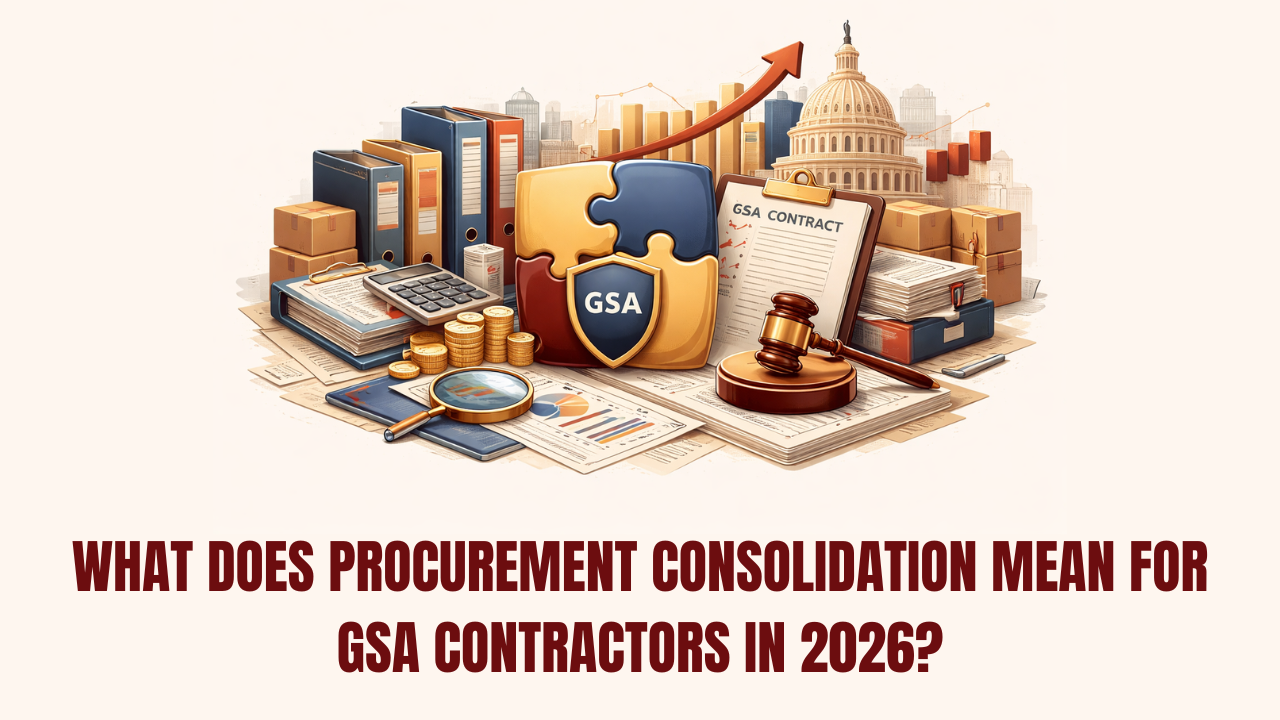
Procurement consolidation is rapidly reshaping how federal agencies buy goods and services, and it’s becoming central to the U.S. General Services Administration acquisition strategy for 2026. Driven by policy and reinforced by shared services initiatives, consolidation is changing how contractors compete, position themselves, and generate revenue on the GSA Schedule.
For contractors, this shift is not theoretical. It is redefining market access, pricing scrutiny, and the long-term value of a GSA Multiple Award Schedule (MAS) contract.
What is procurement consolidation and why does it matter for GSA contractors in 2026?
Procurement consolidation refers to the federal government’s strategy of centralizing purchasing for common goods and services through designated contract vehicles and shared-service platforms. In 2026, this approach elevates GSA’s role as the primary acquisition hub, making contract positioning and compliance more consequential than ever.
In practice, consolidation reduces redundant agency contracts and channels spending through standardized vehicles such as the GSA Schedule. Agencies benefit from streamlined procurement, while contractors face intensified competition within fewer, more strategically managed channels.
This direction is reinforced by Executive Order 14240, which promotes centralized acquisition for common goods and services across federal agencies.
What is Executive Order 14240?
Executive Order 14240 directs federal agencies to consolidate procurement of common goods and services to improve efficiency, reduce costs, and strengthen category management. It positions GSA as a central provider of shared acquisition solutions.
The order supports a government-wide shift toward standardized purchasing through approved contract vehicles, with GSA leading implementation and oversight. As agencies align with this mandate, contractors must adapt to centralized buying patterns and increased scrutiny.
What are “common goods and services” in practical business terms?
Common goods and services are commercially available products and standardized services used across multiple federal agencies. These offerings are prime candidates for centralized purchasing through GSA contract vehicles.
In practical terms, this category includes offerings that are repeatable, scalable, and widely used across the government:
| Category | Examples | GSA Alignment |
|---|---|---|
| IT Hardware & Software | Laptops, cybersecurity tools, cloud subscriptions | IT Category (MAS) |
| Professional Services | Consulting, program management, financial services | Professional Services Category |
| Facilities & Maintenance | Janitorial, HVAC, security services | Facilities Category |
| Office & Industrial Supplies | Furniture, PPE, office products | Office Management Category |
| Telecommunications & Cloud | Network services, SaaS, infrastructure | IT Category |
These are precisely the areas targeted by GSA’s shared-services initiatives, including the Acquisition Shared Services and Solutions Quality Service Management Office (QSMO).
How does centralization benefit some contractors while squeezing others?
Centralization rewards well-positioned GSA contractors with increased visibility and demand, while marginal or misaligned contractors face reduced access to opportunities. Contractors without competitive pricing, strong category alignment, or active contract management are most vulnerable.
When agencies consolidate purchasing through GSA, spending concentrates within fewer contract vehicles. This creates a clear divide:
- Beneficiaries
- Contractors with strong category alignment and competitive pricing
- Firms with active marketing, capture planning, and compliance readiness
- Established GSA Schedule holders with proven performance
- At-Risk Contractors
- Passive Schedule holders with minimal sales activity
- Contractors with outdated pricing or misaligned SINs
- Firms lacking differentiation or market positioning
As consolidation intensifies, weak contract holders become more exposed, while well-positioned vendors gain disproportionate advantage.
Will procurement consolidation increase opportunities on GSA?
Yes. Procurement consolidation is expected to increase federal spending through GSA contract vehicles, particularly for common goods and services. However, opportunities will concentrate among contractors that are strategically positioned and competitively priced.
As agencies shift to centralized buying, GSA’s role as a shared-service provider expands. This trend is reinforced by the establishment of the Acquisition Shared Services and Solutions QSMO, which defines operating models, standards, and vetted solutions for government-wide acquisition.
For contractors, this means:
- Greater demand routed through GSA Schedule contracts
- Increased competition within fewer contract vehicles
- Heightened scrutiny of pricing, compliance, and past performance
- Expanded visibility for contractors aligned with federal categories
How does procurement consolidation affect federal contractors’ market positioning?
Procurement consolidation transforms a GSA Schedule from a passive eligibility credential into a strategic market-positioning asset. Contractors must align their offerings, pricing, and contract vehicles with federal category management priorities.
In a centralized buying environment, success depends on how well a contractor is positioned within the GSA ecosystem:
- Category Alignment: Ensure offerings align with high-demand federal categories.
- Vehicle Fit: Select the right contract vehicle, such as MAS or other strategic GWACs.
- Pricing Defensibility: Maintain competitive, compliant, and audit-ready pricing.
- Capture Planning: Target agencies shifting to centralized procurement.
- Contract Optimization: Keep SINs, pricing, and offerings current and relevant.
Does procurement consolidation favor existing GSA contractors?
Yes, procurement consolidation generally favors existing GSA contractors, particularly those with strong performance history, competitive pricing, and category alignment. Agencies increasingly prefer established, vetted vendors on centralized contract vehicles.
However, not all Schedule holders benefit equally. Passive contractors or those with outdated offerings may face increased risk of inactivity or cancellation as spending consolidates among top-performing vendors.
How should contractors prepare for more centralized buying?
Contractors should prepare by aligning their GSA Schedule with federal category priorities, strengthening pricing defensibility, and actively pursuing opportunities through centralized acquisition channels. Proactive contract management and capture planning are essential.
Preparation strategies include:
- Conducting a category alignment and vehicle fit assessment
- Updating pricing to withstand scrutiny and audits
- Optimizing SINs and contract scope for relevance
- Developing a capture strategy targeting centralized buyers
- Leveraging shared-service initiatives and GSA marketplaces
Our Take
We typically see consolidation elevate top-performing contractors while quietly sidelining passive Schedule holders. In practice, centralized buying increases the value of a well-positioned GSA contract and exposes weaknesses in pricing, compliance, and market alignment. Firms that treat their Schedule as a strategic asset gain visibility, credibility, and sustained access to federal demand.
Frequently Asked Questions
What is Executive Order 14240?
Executive Order 14240 directs federal agencies to consolidate procurement of common goods and services. It strengthens category management and positions GSA as the government’s central acquisition provider.
Will procurement consolidation increase opportunities on GSA?
Yes. As agencies centralize purchasing, more spending flows through GSA contract vehicles. Opportunities will increase, but competition will intensify among strategically positioned contractors.
What products and services are considered “common goods and services”?
Common goods and services include commercially available products and standardized services used across agencies. Examples include IT hardware, professional services, facilities maintenance, telecommunications, and office supplies.
Does procurement consolidation favor existing GSA contractors?
Yes. Existing GSA contractors benefit from increased visibility and access to centralized purchasing channels, particularly when their offerings align with federal category priorities.
How should contractors prepare for more centralized buying?
Contractors should align their offerings with federal categories, maintain competitive and compliant pricing, and actively pursue opportunities through GSA’s centralized acquisition channels. Strategic contract management and capture planning are essential.
Position Your GSA Contract for Centralized Buying
Procurement consolidation is accelerating, and federal agencies are directing more spending through GSA. Contractors that fail to align their Schedule with category priorities, pricing expectations, and shared-service initiatives risk losing visibility and revenue.
At CAP50, we don’t just advise. We execute. From category alignment and vehicle strategy to pricing defensibility and capture planning, we position your GSA contract for success in a centralized procurement environment.