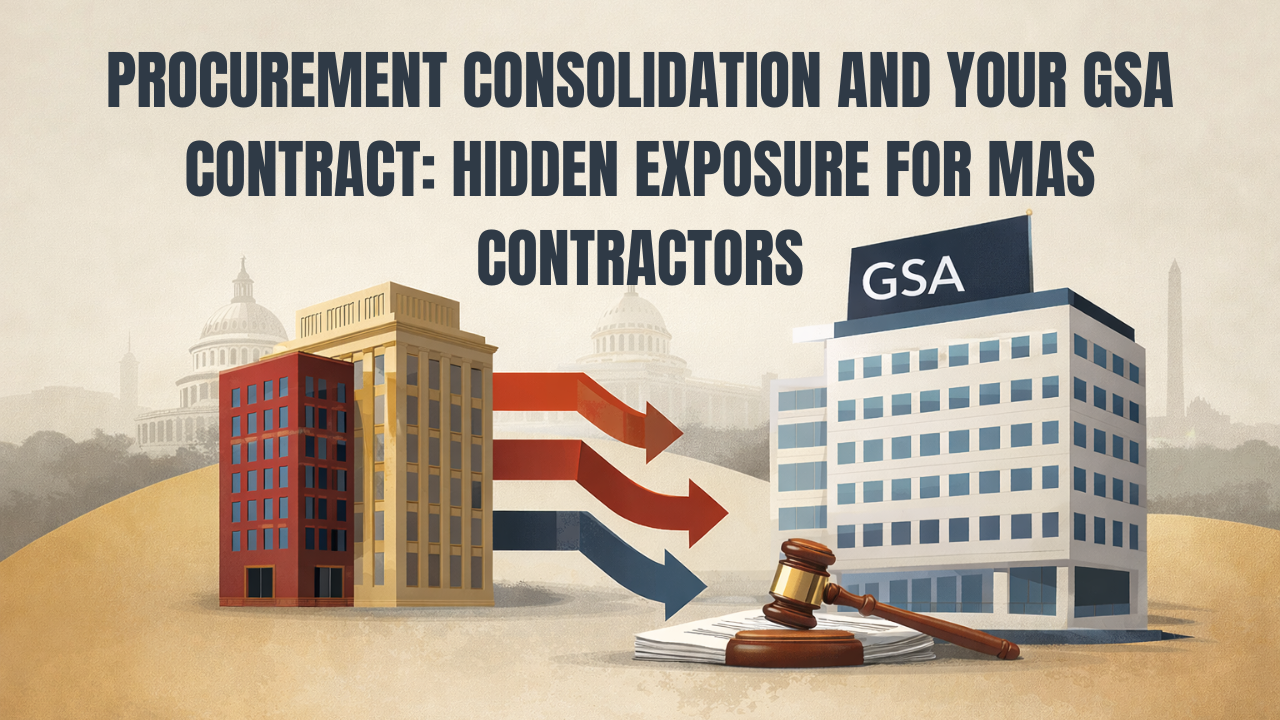
Procurement consolidation is accelerating across federal agencies. Category management mandates, Best-in-Class designations, and contract vehicle rationalization are reducing the number of awarded vehicles agencies rely on. For contractors holding a GSA contract, that shift changes risk exposure. Quietly.
If your offering, pricing structure, or SIN alignment no longer fits where agencies are consolidating spend, your contract can remain active while revenue declines and compliance obligations remain fixed.
A GSA contract is a long-term, pre-negotiated agreement under the GSA Multiple Award Schedule that allows federal agencies to purchase commercial products and services at established terms and pricing. As procurement consolidates around fewer vehicles and prioritized SIN categories, only properly positioned Schedule holders remain competitive.
How Procurement Consolidation Is Reshaping GSA Contract Value
Agencies are narrowing contract usage. Spend is being steered toward:
- Best-in-Class vehicles
- High-demand SIN groupings
- Contractors with proven transactional history
- Vendors aligned with category management goals
The issue is not contract validity.
Under the GSA Multiple Award Schedule governed by FAR Subpart 8.4, agencies retain discretion in how they conduct fair opportunity among Schedule holders. Category management policy overlays that discretion with strategic sourcing objectives. That changes buying behavior without rewriting your award.
A Schedule contract awarded five years ago under a broader competitive pool may now sit in a saturated SIN category with declining federal demand. Your contract remains compliant. But visibility erodes. Task order volume shifts elsewhere.
GSA MAS and SIN Alignment Pressure
The GSA MAS structure consolidates legacy Schedules into a unified vehicle. Within MAS, each contractor is awarded specific Special Item Numbers.
A GSA SIN number determines where your company appears in agency market research, RFQs, and eBuy searches. Misalignment between:
- Your actual commercial offerings
- The awarded SIN scope
- Current agency consolidation targets
creates measurable exposure.
When procurement consolidates around specific SIN clusters, contractors outside those categories experience slower task order flow. That does not trigger termination. It triggers dormancy.
Dormancy, in turn, raises separate compliance questions under the Sales Reporting Clause and minimum sales thresholds.
What Contractors Are Assuming Incorrectly
Capitol 50 consistently sees four incorrect interpretations surface during consolidation periods:
- “If my contract is active, I am positioned correctly.”
- “Agencies will continue using my SIN because they have in the past.”
- “Low sales are temporary and unrelated to procurement strategy.”
- “I can add SINs later without risk.”
Each assumption ignores timing and sequencing risk.
Adding SINs requires technical narrative support, past performance alignment, and pricing justification under the Commercial Sales Practices framework. If consolidation has already shifted buying patterns, reactive modifications often lag demand.
Similarly, contractors waiting until sales drop below the minimum threshold outlined in I-FSS-639 risk closer review during option exercise.
By the time performance data shows decline, agencies have already shifted vehicles.
FAR Clauses Still Apply Even When Demand Shifts
Consolidation does not reduce compliance obligations.
FAR 52.238-80 Industrial Funding Fee and Sales Reporting requires accurate transactional reporting regardless of order volume.
FAR 52.212-4 commercial terms still govern performance.
Most Favored Customer disclosures remain enforceable.
Reduced activity combined with static compliance costs increases administrative exposure per dollar earned. That imbalance often goes unnoticed until an option period review or Contractor Assessment Visit.
When agencies consolidate procurement, GSA evaluates contractor relevance through:
- Sales thresholds
- Pricing competitiveness
- Scope accuracy
- Modification history
- Past performance consistency
Relevance becomes a review variable. Quietly.
The Risk of Prior Termination During Consolidation Cycles
Contractors previously terminated for convenience or cancellation for insufficient sales face additional pressure if attempting re-entry.
Reapplication into the MAS program during a consolidation phase requires stronger:
- Financial documentation
- Technical narratives
- Pricing disclosures
- SIN justification
GSA reviewers evaluate prior performance history alongside current market need. If procurement consolidation has reduced agency demand in your category, approval likelihood shifts.
No denial letter references consolidation directly.
The effect is indirect but measurable.
Corrective Positioning Requires Sequencing, Not Reaction
Capitol 50 approaches consolidation exposure as a sequencing issue:
- Confirm SIN alignment against current federal spend patterns.
- Evaluate pricing position relative to category competitors.
- Review sales velocity versus minimum thresholds.
- Audit Commercial Sales Practices disclosures.
- Assess modification timing before option exercise.
The objective is not expansion.
It is defensibility.
A contractor who understands where agency consolidation is moving can adjust SIN scope, pricing structure, and market positioning before decline appears in reported sales.
Waiting for decline invites formal review.
Where Capitol 50 Steps In
Capitol 50 evaluates whether a GSA Schedule contract remains structurally positioned under current federal consolidation patterns. That review examines compliance posture, SIN competitiveness, sales trajectory, and option risk.
No assumptions.
Documented analysis.
If procurement consolidation is reducing visibility or order volume under your GSA contract, delaying review increases exposure before option exercise or minimum sales evaluation.
An expert contract assessment is available here.
Contract holders who confirm their positioning early retain flexibility.
Those who wait face narrower correction paths.
