A CEO sent me their option letter from GSA with a simple question: “Are we safe?”
They were heading into Year 5 of their MAS base period with $38,000 in total sales. Under today’s thresholds, that contract wasn’t stable — it was exposed.
GSA doesn’t terminate most Schedules dramatically. They let performance data accumulate. By the time you realize you’re behind, the option decision or cancellation review is already in motion.
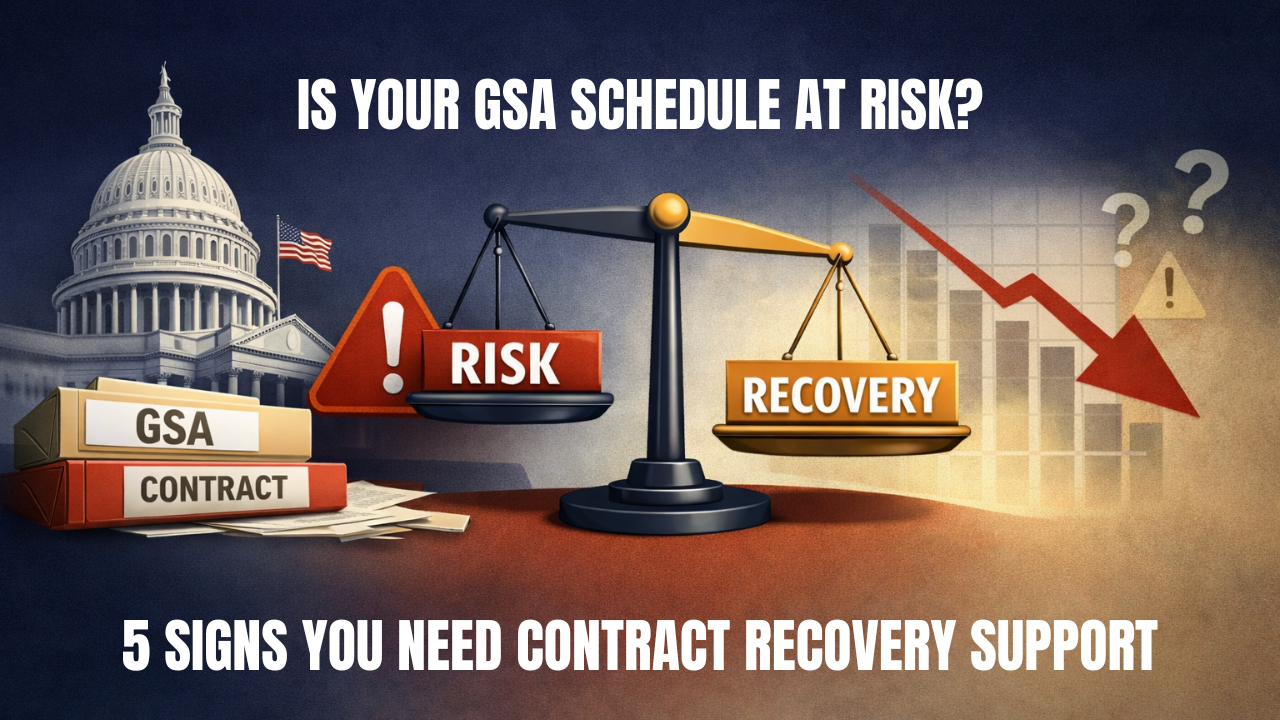
Here are five signals your GSA Schedule may need Contract Recovery support.
Will GSA really cancel my Schedule for low sales?
Yes. If you fail to meet $100,000 in total sales during the 5-year base period—or $125,000 during each 5-year option period—GSA can initiate cancellation or decline your option. Sales performance is a formal contract requirement under MAS.
The minimum sales benchmark is cumulative, not annual:
| Contract Period | Required Sales | What Happens If You Miss It |
|---|---|---|
| Base (First 5 Years) | $100,000 total | Cancellation review possible |
| Each 5-Year Option | $125,000 total | Option may be denied or contract canceled |
The risk isn’t in Year 1. It’s in Year 4 when the math no longer works.
What I’m seeing on the ground
The new 5-year threshold gives contractors a false sense of time. Then they wake up in Year 4 with a $70K–$90K revenue gap and no pipeline velocity to close it.
Low sales usually trace back to:
- Misaligned SIN structure
- Pricing that doesn’t compete in eBuy
- No agency-specific capture strategy
- No federal BD ownership internally
In Contract Recovery work, we assess whether the contract can realistically close the gap—or whether we pivot toward broader federal positioning like OASIS+ or GWAC support to stabilize revenue before the option decision.
What does a Cure Notice or Show Cause letter actually signal?
It means your CO has formally documented performance failure and is building a record. A Cure Notice gives you time to correct deficiencies. A Show Cause letter means termination is actively being considered.
These are not procedural emails. They are legal positioning steps.
Here’s the practical distinction:
| Category | Cure Notice | Show Cause Letter |
|---|---|---|
| Government Position | Deficiency identified | Termination justified unless rebutted |
| Response Time | Typically ~30 days | Often shorter |
| Termination Risk | Escalating | Imminent |
| Strategy Required | Corrective action plan | Defensive + remedial strategy |
Your response determines whether the contract survives.
The reality of the situation
COs aren’t persuaded by apologies. They’re persuaded by control.
A defensible response includes:
- Root cause analysis
- Corrective action timeline
- Structural compliance fixes
- Evidence of implementation
This is where structured Contract Recovery support becomes critical. We don’t just respond to the letter — we rebuild the compliance architecture behind it so the CO sees reduced risk.
Am I exposed if I’m behind on reporting or IFF?
Yes. Missed sales reporting, inaccurate IFF payments (0.75%), or modification gaps create a documented compliance trail. Repeat issues trigger audits, cure actions, or cancellation review.
MAS is compliance-driven. Administrative drift signals contract risk.
Common exposure points:
- Late or inaccurate quarterly sales reports
- IFF miscalculations or unpaid balances
- Outdated pricing tied to commercial changes
- No Economic Price Adjustment strategy
- Lapsed SAM registration
- Unprocessed mod backlog
These problems rarely show up all at once. They stack quietly.
What I’m seeing on the ground
Turnover is the leading cause. The internal GSA administrator leaves. Documentation lives in someone’s inbox. Six months later, the contract is out of alignment.
This is exactly why Post-Award GSA Schedule Management exists. Contractors who treat their MAS contract like an actively governed asset—rather than a static award—don’t end up in recovery mode.
Can my Schedule be “at risk” even if it’s active?
Absolutely. A contract can be technically compliant and strategically irrelevant. That’s how non-performance cancellations happen.
Stagnation indicators include:
- No SIN expansion in years
- Labor rates below market positioning
- Capabilities not reflected in awarded scope
- No Contractor Teaming Arrangements (CTAs)
- No pursuit plan tied to agency forecasts
If your pricing and scope don’t reflect your current capabilities, federal buyers skip you in eBuy.
The reality of the situation
Many firms think they need a new contract vehicle when sales stall. Often, they need to optimize the one they already hold.
In some recovery cases, we restructure the existing Schedule. In others, we integrate OASIS+ or additional GWAC positioning to diversify revenue streams before option review. The strategy depends on whether the Schedule is mismanaged — or mispositioned.
How do I know if I’m ready for a CAV or audit?
If you cannot immediately produce pricing support documentation, Commercial Sales Practices disclosures, and IFF reconciliation data, you are not audit-ready. And audit findings can trigger financial liability or contract action.
GSA Contractor Assessment Visits (CAVs) are increasingly focused on pricing integrity and disclosure accuracy.
Here’s a simple readiness check:
- Basis of Award pricing documentation organized
- CSP disclosures aligned with current practices
- Tracking for Most Favored Customer (if applicable)
- IFF payments reconciled quarterly
- Modification history reflects awarded scope
Two unchecked boxes indicate vulnerability. Three signal material exposure.
What I’m seeing on the ground
Preparing before a CAV is operational work. Repairing findings afterward is legal and financial damage control.
Advanced Contract Recovery often begins with an internal audit simulation. We stress-test the contract before GSA does — and fix weaknesses proactively.
Bottom Line
GSA Schedules don’t usually collapse suddenly. They degrade through:
- Cumulative sales shortfalls
- Compliance drift
- Strategic stagnation
- Audit exposure
The updated $100K base and $125K option thresholds have raised the performance bar. The timeline feels longer — but the financial target is materially higher.
The contractors who stay secure treat their MAS contract as a managed federal asset. They monitor cumulative sales early. They align SINs with strategy. They maintain compliance infrastructure.
The contractors who wait for a Cure Notice end up negotiating from weakness.
If your Schedule is entering Year 3, Year 4, or approaching an option decision, the strategic move isn’t panic — it’s assessment.
Determine whether you need disciplined post-award management, structured Contract Recovery, or a broader federal vehicle strategy to protect the health of your contract portfolio before GSA makes the decision for you.