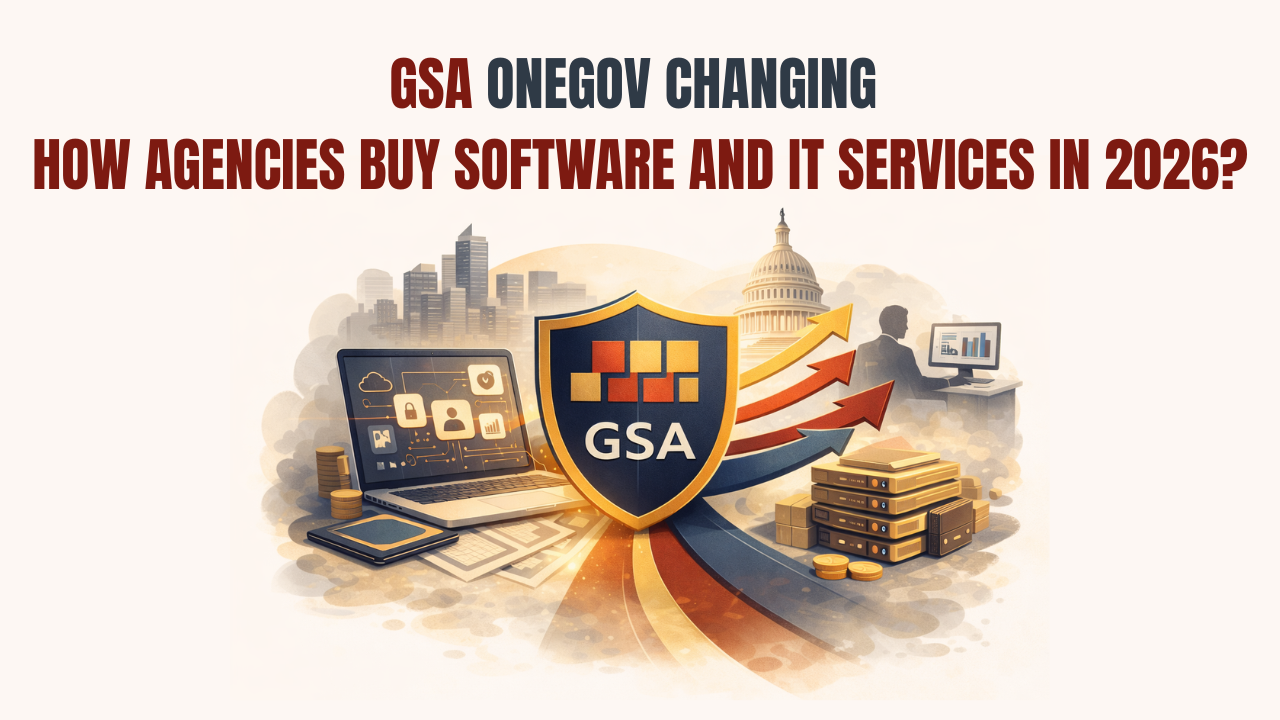
Federal agencies are accelerating their shift toward shared acquisition models, and OneGov sits at the center of that transformation. As the U.S. General Services Administration expands standardized software agreements and negotiates enterprise pricing, IT vendors are facing a clear signal about where federal demand is heading in 2026. For commercial technology companies, OneGov is not just a program. It represents a strategic market direction.
What Is GSA OneGov?
GSA OneGov is a shared acquisition initiative that negotiates standardized terms, pricing, and enterprise agreements for software, cloud, and cybersecurity across federal agencies. It enables agencies to purchase through pre-negotiated governmentwide deals, streamlining procurement while driving cost savings and consistency.
Launched and promoted by the U.S. General Services Administration, OneGov consolidates buying power across agencies to secure favorable pricing and reduce acquisition friction. As of 2025–2026, the program has generated more than $1 billion in savings and spans over 20 active offers across major technology categories, including software, cloud services, and cybersecurity solutions.
How Does OneGov Fit Into Procurement Consolidation and Shared Services?
OneGov is a cornerstone of federal procurement consolidation, aligning with broader shared services initiatives designed to reduce redundancy and improve efficiency. Agencies increasingly rely on centralized acquisition vehicles to standardize terms and accelerate technology adoption.
This shift reflects a governmentwide emphasis on:
- Shared acquisition models that leverage collective buying power
- Standardized contract terms across agencies and vendors
- Centralized IT procurement strategies aligned with modernization goals
- Reduced administrative burden through pre-negotiated agreements
- Enterprise-level pricing for software, cloud, and cybersecurity solutions
In practice, agencies are moving away from fragmented, one-off purchases and toward governmentwide solutions that deliver speed, consistency, and cost savings.
Why Should Software Vendors Expect Stronger Pressure on Pricing Standardization?
OneGov increases pricing transparency and standardization, placing pressure on vendors to offer consistent, defensible federal pricing structures. Vendors participating in shared acquisition agreements must align with enterprise-level discounts and uniform licensing terms.
This trend creates several implications for IT vendors:
| Impact Area | What Vendors Should Expect |
|---|---|
| Pricing Strategy | Increased scrutiny on commercial sales practices and discounting |
| Licensing Models | Standardized terms and simplified federal licensing structures |
| Competition | Greater visibility among competitors within shared agreements |
| Negotiations | Enterprise-level negotiations rather than agency-by-agency deals |
| Compliance | Stronger alignment with federal acquisition regulations and policies |
Agencies are prioritizing predictability and transparency. Vendors that cannot support standardized pricing or scalable licensing models may face barriers to entry.
Does OneGov Replace the GSA Schedule?
No, OneGov does not replace the GSA Multiple Award Schedule (MAS). Instead, it operates as a strategic layer built on top of existing contract vehicles. Most OneGov agreements leverage the MAS program as the underlying acquisition pathway.
The relationship between the two is complementary:
- GSA Schedule (MAS): The foundational government contract vehicle that enables vendors to sell to federal agencies.
- OneGov Agreements: Enterprise-level arrangements negotiated using MAS to standardize terms and pricing across agencies.
- Shared Acquisition Software Programs: Strategic initiatives that streamline procurement and increase adoption of governmentwide solutions.
For contractors, OneGov reinforces the importance of holding a MAS contract while positioning strategically within shared acquisition channels.
How Do Software Companies Sell Through GSA in 2026?
Software companies sell through GSA in 2026 by leveraging the MAS contract, aligning with shared acquisition initiatives like OneGov, and positioning within federal IT category management strategies. Success requires more than contract ownership. It demands strategic alignment with how agencies prefer to buy.
Key pathways include:
- Obtaining a GSA Multiple Award Schedule (MAS) contract to access federal buyers
- Participating in shared acquisition agreements such as OneGov software offers
- Aligning pricing and licensing models with standardized federal expectations
- Engaging with category management initiatives within the IT sector
- Building relationships with agency buyers and GSA contracting officers
Federal software buying through GSA is increasingly centralized, favoring vendors that support enterprise solutions and scalable licensing.
Is OneGov Only for Large Vendors?
No, OneGov is not limited to large vendors, but it tends to favor providers with scalable solutions, mature pricing structures, and enterprise-ready capabilities. While many early agreements involve major technology companies, smaller and mid-sized firms can participate through MAS and strategic alignment.
Smaller vendors can remain competitive by:
- Offering specialized or niche software solutions
- Demonstrating scalable licensing and deployment models
- Maintaining compliant and transparent pricing structures
- Positioning as subcontractors or partners within shared agreements
- Aligning with federal cybersecurity and cloud standards
OneGov reflects demand for enterprise-ready solutions, not vendor size alone.
Does OneGov Compete With, Complement, or Reshape MAS Selling Strategy?
OneGov complements the MAS program while reshaping how vendors approach federal sales strategy. It does not replace MAS but elevates the importance of strategic positioning within shared acquisition channels.
| Aspect | MAS Traditional Approach | OneGov-Influenced Strategy |
|---|---|---|
| Sales Model | Agency-by-agency pursuit | Governmentwide enterprise agreements |
| Pricing | Negotiated per opportunity | Standardized, enterprise-level pricing |
| Visibility | Individual agency outreach | Centralized exposure across agencies |
| Contract Role | Access vehicle | Strategic platform for shared agreements |
| Growth Strategy | Transactional sales | Enterprise positioning and category alignment |
Vendors that treat MAS as a passive listing risk falling behind as agencies adopt shared acquisition pathways.
What Should Contractors Do If They Are Not Yet Positioned for Federal Software Channels?
Contractors not positioned for federal software channels should secure a MAS contract, align pricing with federal expectations, and develop a targeted GSA channel strategy. Early positioning is essential as shared acquisition models gain traction.
Recommended steps include:
- Assess federal readiness for pricing, compliance, and licensing structures
- Pursue a GSA Schedule (MAS) contract to establish market access
- Align with OneGov software agreements and shared acquisition initiatives
- Develop a federal channel strategy focused on IT category management
- Invest in compliance and reporting infrastructure to support federal sales
Why Isn’t Having a GSA Schedule the Same as Being Strategically Aligned With Software Demand?
Holding a GSA Schedule provides access to the federal market, but strategic alignment requires positioning within shared acquisition initiatives and enterprise demand trends. Contractors with inactive or underutilized Schedules often lack visibility within centralized procurement programs like OneGov.
A MAS contract is the entry point. Strategic alignment requires:
- Competitive, standardized pricing and licensing models
- Participation in shared acquisition agreements
- Alignment with federal IT modernization priorities
- Active engagement with GSA category management initiatives
- Continuous contract optimization and marketing
Our Take
We see OneGov as a clear signal of where federal software procurement is heading. Agencies want standardized terms, predictable pricing, and enterprise-ready solutions delivered through centralized channels. Vendors that align early gain visibility, influence negotiations, and secure long-term positioning within federal IT category management.
Frequently Asked Questions
What is GSA OneGov?
GSA OneGov is a shared acquisition initiative that negotiates standardized pricing and terms for software, cloud, and cybersecurity solutions across federal agencies. It enables agencies to purchase through governmentwide agreements, improving efficiency and generating significant cost savings.
Does OneGov replace the GSA Schedule?
No, OneGov does not replace the GSA Schedule. It operates as a strategic layer built on MAS contracts, leveraging them to establish enterprise agreements and shared acquisition solutions.
How do software companies sell through GSA in 2026?
Software companies sell through GSA by obtaining a MAS contract, aligning with shared acquisition initiatives like OneGov, and positioning within federal IT category management programs. Success requires standardized pricing, compliant licensing, and a targeted federal sales strategy.
Is OneGov only for large vendors?
No, OneGov is not exclusive to large vendors. While many agreements involve major technology providers, small and mid-sized firms can participate through MAS contracts, partnerships, and specialized solutions.
Should software firms pursue MAS, OneGov alignment, or both?
Software firms should pursue both a MAS contract and alignment with OneGov initiatives. MAS provides market access, while OneGov positioning enhances visibility, competitiveness, and enterprise-level opportunities.
Unlock Advanced Federal Opportunities with CAP50
Winning in the federal software market is shifting toward shared acquisition, enterprise agreements, and centralized procurement models. If your organization is not aligned with MAS and OneGov initiatives, you risk missing the fastest-growing federal IT opportunities.
CAP50 executes end-to-end GSA market entry, IT category acquisition strategy, pricing alignment, and channel positioning. We help software vendors secure their MAS contracts and align with shared acquisition agreements like OneGov.