The Hidden Requirements That Stall 70% of Offers
Every month, Capitol 50 reviews companies eager to pursue the GSA Schedule—often convinced they’re ready, polished, and only a few clicks away from submission. And yet… nearly 70% of would-be contractors hit a wall before their offer even reaches a contracting officer’s desk.
The obstacle isn’t the GSA.
It’s the unspoken readiness gap: the buried rules, subtle compliance triggers, and structural misalignments that quietly disqualify businesses long before pricing enters the conversation.
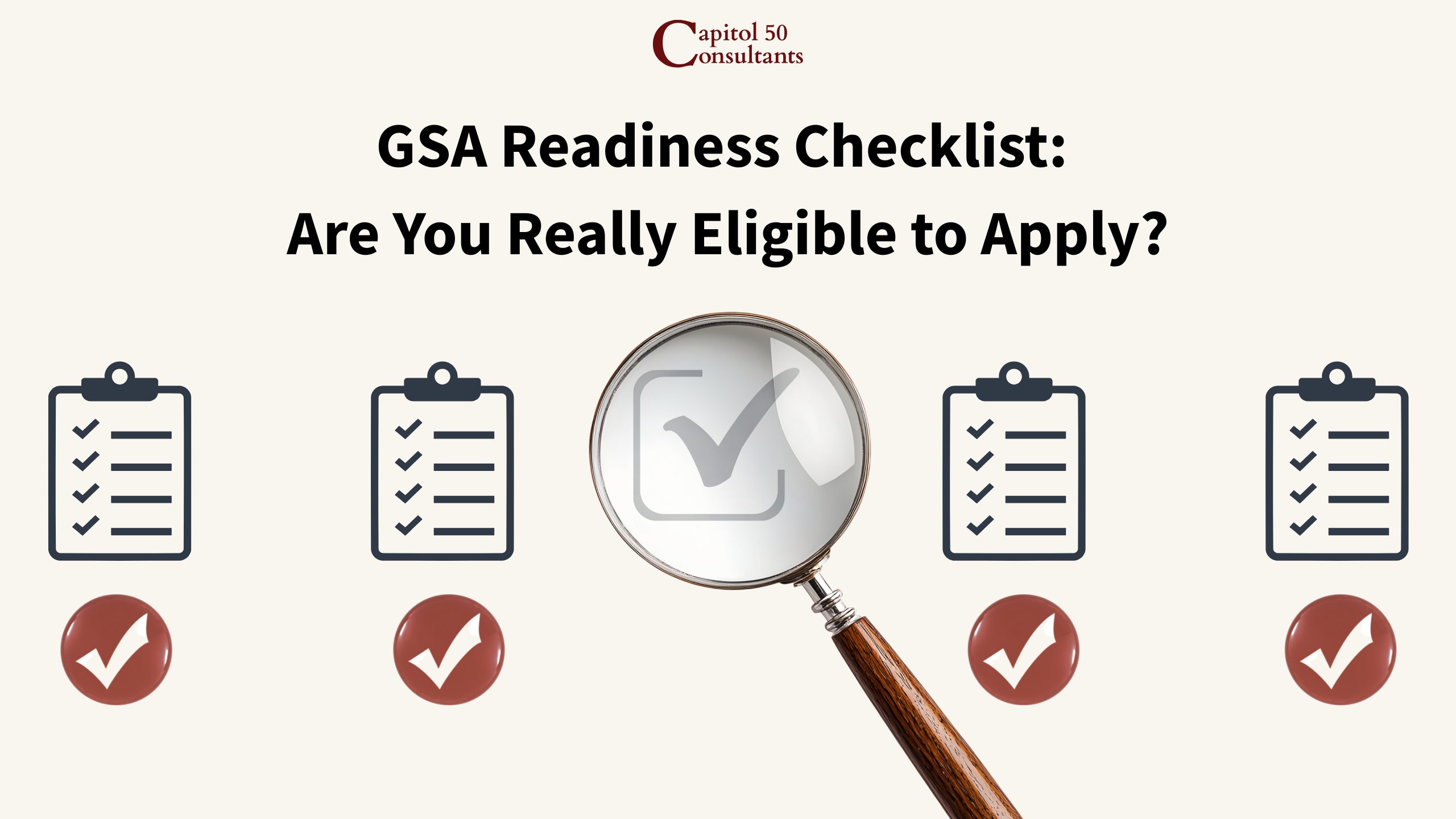
Below is a readiness checklist that cuts past the surface-level guidance found on GSA commercial platforms and addresses the real criteria that stop offers cold.
1. The “Minimum Two Years” Myth: Yes, Age Matters—but Not the Way You Think
Many firms assume two years in business automatically qualifies them. Except age is only one faint signal. Contracting officers want proof of sustained, billable performance—not a corporation formed on paper and left to drift.
Thin past performance, inconsistent delivery, or work with no government analog can freeze an offer in place.
The question isn’t what is a GSA contract? It’s whether your operational history shows you can handle one without stumbling.
A company with three years in business and a single client is often less ready than a one-year-old firm with strong subcontracting records. It feels backward. Still true.
2. Financial Stability Screens That Applicants Rarely Notice
A quiet financial review happens behind every GSA offer. Cash flow patterns, revenue trajectories, and taxable income signals all matter. One year of negative net income doesn’t automatically sink you—but it forces explanations that must be exact.
Common hidden disqualifiers:
- Large revenue swings with no supporting notes.
- Owner draws that strip working capital.
- High debt ratios suggesting shaky delivery capability.
Many companies never evaluate their own financials through a contracting officer’s lens. And that oversight costs time—sometimes months.
3. Your Pricing Has to Match the Government’s Logic, Not Your Own
This is where most offers fall apart. While the historical Most Favored Customer (MFC) model still applies to many service contracts today, it’s being phased out. Contracting officers now rely more on price reasonableness reviews, market indicators, and discount relationships to judge whether your rates make sense within the federal environment.
You don’t get to simply list your pricing; you must defend it.
Red flags that collapse offers:
- Retail vs. reseller structures that contradict your stated discounts.
- Billing terms that vary wildly across commercial clients.
- Sales activity implying customers already receive deeper discounts than your proposed GSA rates.
If your pricing narrative strays from your invoices, you’re not ready.
4. Your Products and Services Must Match the GSA SIN Definitions Exactly
Many applicants think they’ve selected the correct GSA SIN number—until they discover that their offering doesn’t align with required scope. Even slight misalignment can lead to immediate rejection.
Some firms skim SIN descriptions instead of studying cross-references, notes, and exclusions.
A tech services firm, for example, might chase IT SINs when their work actually belongs under professional services. That mismatch ends the offer before pricing is even reviewed.
5. Hidden Compliance Requirements That Stop Offers Mid-Upload
Capitol 50 sees these issues weekly:
- SAM.gov profile incomplete or NAICS codes mismatched.
- Missing digital certificates or expired notarized letters for multifactor authentication.
- Representations and certifications in SAM that contradict documents uploaded into eOffer.
- Labor categories with education or experience requirements that don’t match industry standards.
These aren’t embarrassing slips—they’re structural traps.
6. Past Performance Narratives That Fail to Prove Repeatability
The GSA doesn’t only want to know what you did. It wants to know whether you did it consistently and under conditions similar to federal delivery environments.
Narratives fall short when they:
- Stay too high-level, with no metrics or concrete outcomes.
- Omit contract values, timelines, or scope.
- Fail to tie the service performed to the SIN being pursued.
A narrative without specifics isn’t evidence. It’s just a story.
7. When Should You Bring in a GSA Contract Consultant
Before you begin the offer—never after a rejection.
A strong consultant protects you from misinterpretation, overconfidence, and incomplete documentation. Capitol 50 routinely reviews “nearly ready” companies that are, in reality, months away from true eligibility.
Structural readiness. Pricing defensibility. SIN alignment. Compliance accuracy.
These aren’t details to guess at.
Is Your Company Truly Ready? Get a Real Assessment
If even one section above raised questions, you’re not alone. Most firms misunderstand their readiness until a contracting officer flags an issue deep in the process.
Capitol 50 provides a Contract Qualification Review—a structured readiness assessment that identifies barriers before you submit.
Start here:
https://Cap50.com/contract-qualification-review/
If you need a faster route for full GSA strategy support:
https://Cap50.com/request-a-free-audit/